Daily Carry
The organized backpack: how the wrong setup drains us
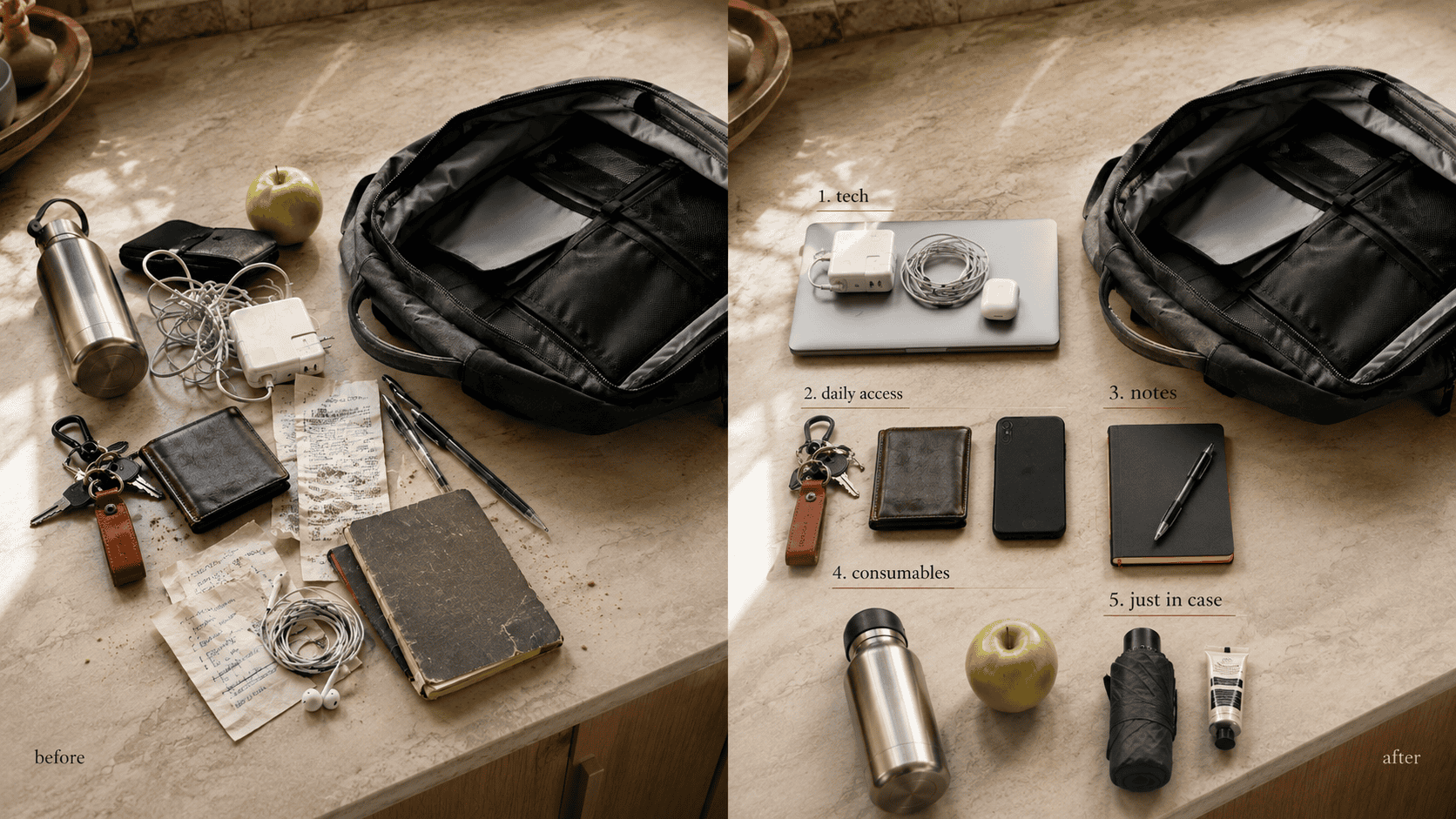
“We can never find anything in our bag.”
Most of us have said some version of this out loud. At a register, with a line forming. At the door, with the rain starting. At the gate, with the boarding group already moving. The bag is right there on our shoulder, and somehow the thing we need is at the bottom of it, under the cables and the receipts and the half-eaten granola bar that we forgot was even in there.
A messy backpack is a small daily friction we have stopped noticing. The wear it puts on our morning is real, even if no one ever measured it in a study.
The bag we never look at
Try this once. Empty the bag tonight. Everything. On the table, on the counter, on the floor.
Now look at the pile.
There is the laptop and the charger. Fine. There is the wallet. Good. There is, somewhere in there, the thing we actually needed today. There is also a charger we have not used in two weeks. A pen that does not write. Three receipts. Some lip balm. An old grocery list. A snack wrapper. Mystery crumbs at the bottom of the main compartment.
None of that is unusual. Almost every bag looks like this. Nobody stops in the middle of a Tuesday to audit what they have been carrying. Things go in. Almost nothing comes out. By month four, the bag has its own little ecosystem and we are quietly subsidizing it with shoulder space.
The search tax
Every time we dig through a bag for our keys, our brain runs the same small loop. It stops what it was doing. It scans. It rules things out. It tries to remember whether we put the keys in the front pocket or the side pocket or the jacket we are no longer wearing. Then, when we find them, it tries to pick up the thread of whatever we were doing before.
We do this four or five times every morning. Wallet. Keys. Phone. Earbuds. Transit card. Each one a small reset. Each one a small drain.
No study has actually timed how long it takes to find keys in a backpack. The number “fifteen seconds” gets quoted online, but no one has measured it. What we can say is that the pattern itself is real, and it is happening more often than we notice.
This is also a quiet contribution to morning decision fatigue. Every “where did I put it” is a small decision the brain did not need to be making.
How to organize a backpack: a layout with zones
The fix is almost embarrassingly simple. Give every category one home.
Not every item. Every category. The brain is good at remembering “tech goes in the back pocket.” It is bad at remembering “the small white cable that came with the second laptop is in the side mesh.”
A version that works for most commuters:
Five zones in a working backpack
How to organize a backpack: a layout that holds up
- Tech. Laptop, charger, cables, earbuds. One pocket, ideally padded, ideally close to the spine.
- Daily access. Keys, wallet, phone, transit card. A small pocket that opens fast, near the top.
- Notes and reading. Notebook, tablet, kindle, whatever holds our attention on the train. One slim pocket, easy to slide in and out.
- Consumables. Water bottle, snack, sanitizer, gum, lip balm. Often the side pocket plus one small interior slot.
- Just in case. Umbrella, charger backup, hand cream, the things we carry but rarely touch. One smaller compartment we can ignore most days.
If a category does not get its own pocket, it migrates. The keys end up under the laptop. The earbuds disappear into the consumables zone. The bag stays messy because the categories never had homes to begin with.
The five-zone setup also doubles as a clean answer to a question we rarely ask out loud: what are the actual work bag essentials? Whatever earns a permanent spot in those five zones. Everything else is a candidate for removal at the next reset.
See the friction. And fix it.
The car smell. The dying phone. The bag that’s never quite right. One overlooked commute problem each week, and the simplest fix.
The weight question
We do not notice the weight day by day. We notice it on the third Friday of a long week, when the same bag suddenly feels heavier than it did on Monday. The bag did not gain weight. We just stopped accounting for it. The American Chiropractic Association suggests a carried bag should stay under 10 percent of body weight, which for a 160-pound adult is 16 pounds. A laptop, charger, water bottle, lunch, and a notebook can reach that ceiling without trying. The fix is rarely a different backpack. The fix is removing what we are carrying without thinking about. Lighter is the article’s other contribution to the strap pain we have been ignoring.
The Sunday night reset
This is where the article turns into a useful habit instead of an observation. The habit has a name, though most people who do it never call it that.
The Sunday Night Reset. Ninety seconds. Empty the bag, wipe out the dust at the bottom, check what should be charged, return only what gets used in a typical week. Put the bag by the door.

It is the kind of small action that sounds so minor it cannot possibly matter, which is exactly the reason most people never do it. Small daily frictions go unfixed because they never quite hit the threshold of “I need to deal with this.” A weekly reset solves an entire category of friction without ever crossing that threshold during the week.
There is real research behind why this works. Psychologist Peter Gollwitzer documented something called implementation intentions in 1999. The short version: if we pre-commit to a specific time and place for a specific small action, the chance we actually do it goes up significantly. Across 94 studies, the effect was medium to large. The wording is always the same shape: “On Sunday night, after dinner, I will reset the bag.”
This is also why the Sunday Night Reset works better than “I should organize my bag more.” Vague intention does almost nothing. Time-and-place intention does a lot.
The 90-second number is not a hack and not a claim. It is the realistic length of the action, sitting deliberately just under James Clear’s well-known two-minute rule for habit formation. Below two minutes, the friction-defeating premise of the habit holds. Above two minutes, we start finding reasons to skip it.
Researchers have also shown that small behaviors take a median of 66 days to feel automatic, with a wide range of 18 to 254 days depending on the person and the behavior (Lally et al. 2010). Translation: nine to ten Sunday-night resets in, the action stops feeling like a task. By six months, the bag almost resets itself.
That is also roughly the timeline for a designed morning to start paying back the small attention it took to set up.
Start with one thing
If a full reset feels like too much to begin with, start with the keys. Pick one fixed pocket. Always the same one. For one week, force the keys to go in that pocket and nowhere else.
By the end of the week, the brain stops searching. The first thing it reaches for on the way out is that pocket, and the keys are there. One small piece of morning friction quietly disappears.
Then add the phone. Then the wallet. Then the transit card. One zone at a time, no full bag overhaul required.
This is what an organized backpack actually is. Not a Pinterest layout. Not a perfectly tidy interior. Just a bag where the things we reach for most have a place we reach for first, and the things we rarely touch are tucked out of the way.
The reward shows up where we did not expect it. Not in the bag itself. In the first ten minutes of the morning, when nothing makes us look down and sigh.
See the friction. And fix it.
See the friction. And fix it.
The car smell. The dying phone. The bag that's never quite right. One overlooked commute problem each week, and the simplest fix.
Keep reading
Daily Carry
The Bag Strap Problem We All Ignore
What carrying the bag on one shoulder is doing to the trapezius. And the fix that takes thirty seconds.
Daily Carry
Our Lunch Is Leaking
The other thing inside the bag we have stopped checking on. The container, the spill, and the fix that takes one trip to the drawer.
Mind & Commute
We've Already Used Our Best Thinking Before We Leave the House
The morning version of decision fatigue and the night-before fix.
Mind & Commute
Monday Blues and the Region Beta Paradox
Why we tolerate the small daily friction that drains us, and never quite fix it.