Car Commuting
The Car Essentials List We Actually Use
Most car essentials lists are shopping lists. This one is built backwards, from the small things that actually go wrong on a daily drive and the few items that quietly fix them.
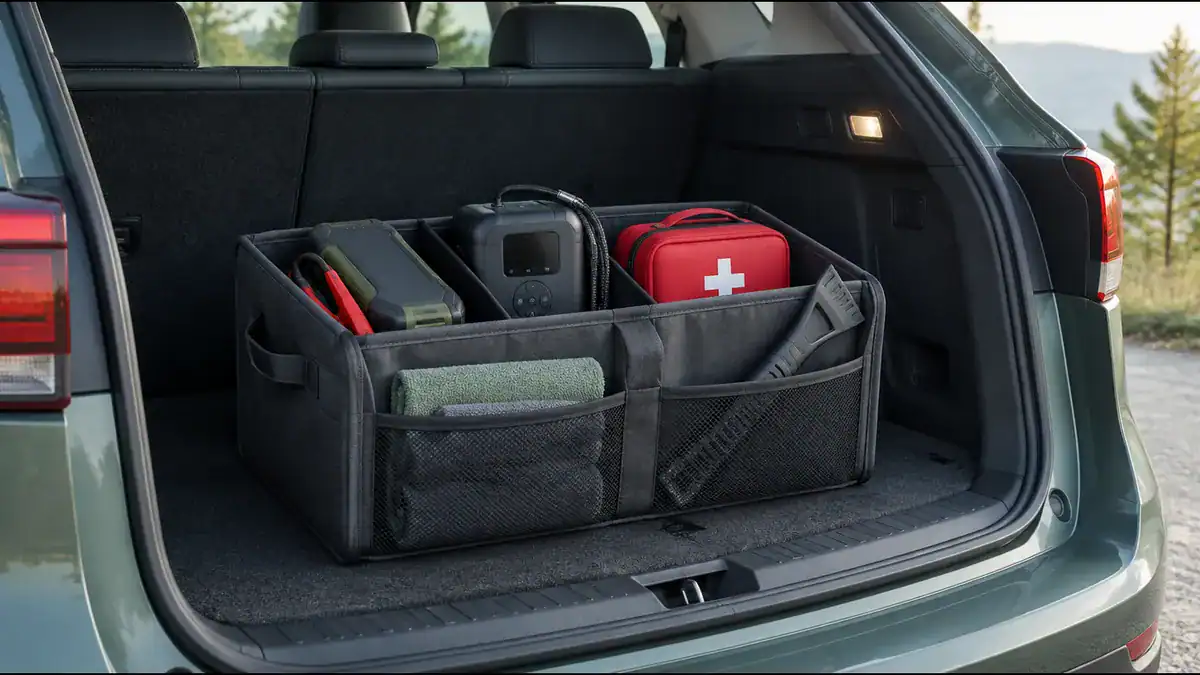
The short answer: the car essentials worth keeping in every car fall into four groups. A just-in-case kit: a lithium jump starter, a portable tire inflator and a small first aid kit. A see-clearly kit: a windshield cleaning tool, an ice scraper or sunshade for the season, and a headlight restoration kit once the lenses yellow. A clutter kit: a trunk organizer, a car trash can and a seat gap filler. And an everyday kit: a fast car charger, microfiber towels and something that removes odor rather than covering it.
Search for car essentials and we get the same picture every time. A trunk full of matching bins, forty products, half of them labeled, most of them never touched.
That is not how a car gets used. A daily driver needs very little most days, and exactly one specific thing on the day something goes wrong: the battery is dead in a dark parking garage, the tire pressure light comes on at 7 a.m., the windshield fogs over and won’t clear.
So this list works the other way around. We started from the frictions that keep showing up on real commutes, the ones we have written about one by one, and kept only the items that solve them. Everything here earns its space.
The just-in-case kit: what we hope never to use
These are the essentials that sit untouched for months and then matter more than anything else in the car. They belong in the trunk, together, in one spot we can find in the dark.
A lithium jump starter. A dead battery used to mean waiting for a stranger with cables. A compact lithium jump starter starts most cars on its own, fits in a glove box, and doubles as a power bank. NOCO is the brand Reddit’s car communities recommend most often for jump starters, and the NOCO Boost GB40 is its long-running default: it’s sized for most gas engines and has safeguards against hooking the clamps up backwards. The one habit that matters is recharging it every few months, because a jump starter is only useful if it’s charged when we need it.
A portable tire inflator. Tire pressure drops on cold mornings, and the warning light tends to come on at the worst possible moment. A small inflator that plugs into the car’s 12V outlet takes a tire from “is this safe?” back to the pressure on the door-jamb sticker in a few minutes, and lets us check all four tires at home instead of hunting for a working gas-station pump. One tip from owners and reviewers: check the inflator’s reading against a separate tire gauge the first time, because built-in gauges on portable inflators can read slightly high.
A compact first aid kit. Not a trauma kit. Just bandages, antiseptic wipes, pain reliever and the small things that handle a cut finger or a scraped knee on the way somewhere.
The just-in-case kit
Dead battery
NOCO Boost GB40 Jump Starter
A compact lithium jump starter for most gas engines, with reverse-polarity protection and a USB port for charging a phone.
For anyone who parks in garages, lots or anywhere help is slow.
Low tire
AstroAI Portable Tire Inflator
Plugs into the 12V outlet, shows pressure on a digital gauge and shuts off automatically at the set pressure.
For cold mornings and the tire light that always comes on at the wrong time.
Small injuries
BAND-AID Travel First Aid Kit
An 80-piece kit in a small case that fits a glove box or door pocket.
For the everyday scrapes, not emergencies.
One honest note: none of these replace roadside assistance or a working spare tire. They cover the small failures that would otherwise end a morning, which on a commute is most of them.
The see-clearly kit: windshield, glare and headlights
Visibility is the essential we forget, because it fades slowly. We wrote about the oily film on the inside of the windshield that turns low sun into glare, and about cloudy headlights that lose a large share of their light without us noticing. Both have cheap, simple fixes that belong in the car.
A windshield cleaning tool and a tint-safe cleaner. A long-handled tool like the Invisible Glass Reach & Clean gets into the bottom corners of the windshield, and an ammonia-free glass cleaner lifts the film without harming tint. Ten minutes a month.
A seasonal glass tool. In winter, an ice scraper with a snow brush, like this 27-inch AstroAI scraper. In summer, a windshield sunshade such as the EcoNour folding shade, which keeps the cabin cooler and slows the heat-driven off-gassing that coats the glass in the first place.
A headlight restoration kit, when the lenses yellow. Not something to carry, but something to own once the headlights start to haze. A ceramic kit like Cerakote’s takes an afternoon. We compared the main options in Cerakote vs 3M vs Sylvania.
The clutter kit: a place for everything that rides along
A car slowly turns into a messy bag on wheels: receipts, cables, a water bottle rolling under the brake pedal, a phone that slides into the gap beside the seat. Three items stop most of it.
A trunk organizer. A collapsible organizer with dividers, like this HOTOR trunk organizer, gives the just-in-case kit a permanent home and keeps groceries from sliding into it.
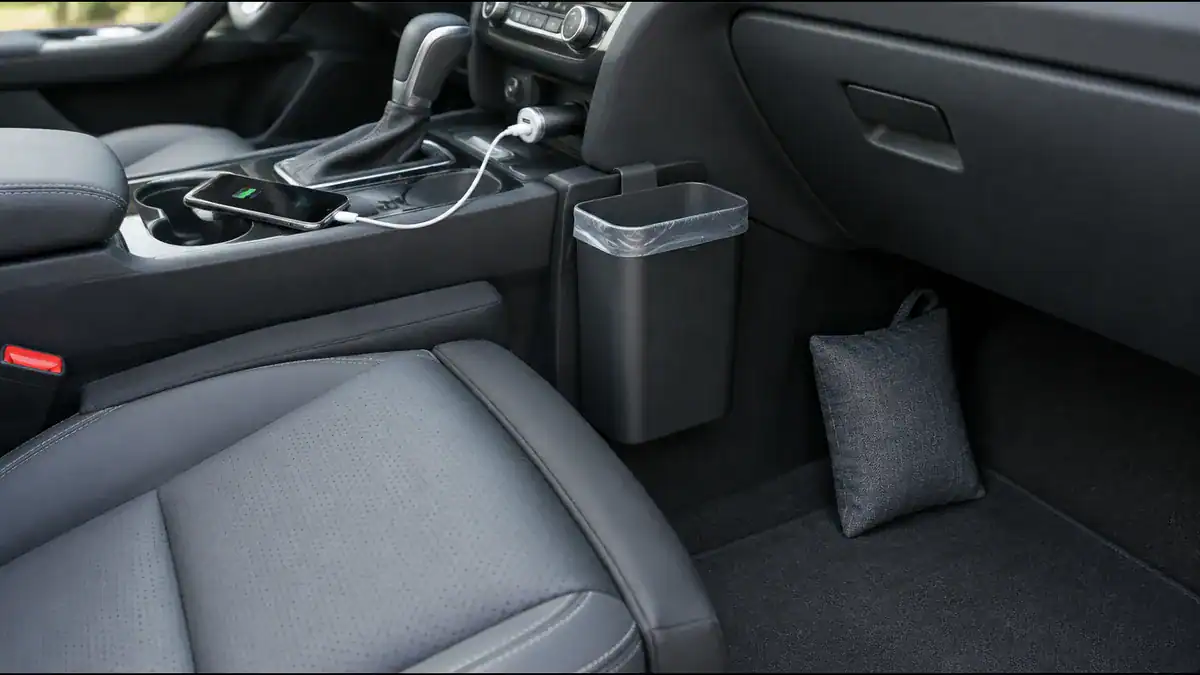
A car trash can with a lid. Without one, trash collects in door pockets and cup holders and the car slowly starts to smell. A lidded, leak-resistant bin like the Lusso Gear car trash can hangs behind the console or seat and gets emptied at every fill-up. AutoGuide named it the most stylish car trash can it reviewed; the trade-off is size, since its 2.5-gallon body can feel large in a small car.
A seat gap filler. The gap between the seat and the console swallows phones, keys and fries. A filler like Drop Stop closes it. It sounds trivial until we count how many times we have reached down there while stopped at a light. The one complaint from hands-on testers is that it can work loose when the seat slides, so a quick tug to reseat it now and then is part of owning one.
The everyday kit: charging, cleaning and air
A fast car charger. Navigation drains a phone faster than almost anything, which is part of why our phone battery drains so fast on the commute. A two-port USB-C charger like the Anker 40W car charger keeps up with maps and music, and the second port is for whoever is in the passenger seat.
Microfiber towels. For the windshield, the dashboard, a spilled coffee. A small stack of waffle-weave towels in the door pocket handles all of it without lint.
Something that removes odor. Not a hanging fragrance. As we explain in our guide to the best car odor eliminator, scent only covers smell, and we stop noticing our own car’s air within days. A charcoal air purifying bag under a seat absorbs odor instead, and recharges in sunlight.
The everyday kit
Charging
Anker 40W USB-C Car Charger
Two ports, fast enough to keep a phone charging while navigation runs.
For anyone who arrives at work with less battery than they left with.
Clutter
Lusso Gear Car Trash Can
A lidded, leak-resistant bin that hangs from a seat or console and keeps trash out of door pockets.
For the car that slowly fills with receipts and wrappers.
Odor
MOSO Natural Air Purifying Bag
Bamboo charcoal that absorbs odor instead of masking it. Fragrance-free and reusable.
For the car smell we have stopped noticing.
How we pack it: four zones, nothing loose
A list only helps if everything has a fixed place. Four zones cover it.
- Trunk bin: jump starter, tire inflator, first aid kit, a spare microfiber towel, and the seasonal tool (scraper in winter, sunshade in summer when it’s not in use).
- Glove box: registration and insurance, a pen, tire pressure gauge if the inflator lacks one, a few napkins.
- Driver’s door pocket: the windshield towel and nothing else that can roll.
- Console area: the charger, a short cable, and the trash can within reach.
Twice a year, when the clocks change, we do a five-minute check: recharge the jump starter, check the tire inflator works, restock the first aid kit, and swap the seasonal tool. It is the same reminder many fire departments use for smoke alarm batteries, and it works just as well for a car.
None of this makes a car feel new. It makes a car feel handled. The commute stops having small, avoidable ways to go wrong, and that quiet is the whole point.
Carry smarter. Commute better.
Common questions about car essentials
What are the most important car essentials to keep in the car?
A charged jump starter, a portable tire inflator, a small first aid kit, a phone charger, an ice scraper or sunshade for the season, and a way to keep the windshield clean. These cover the most common small failures on a daily drive: a dead battery, low tire pressure, poor visibility and a dead phone.
What should be in a car emergency kit?
At minimum: a jump starter or jumper cables, a tire inflator or working spare with the tools to change it, a first aid kit, a flashlight, water, and a phone charger. In cold climates, add an ice scraper, gloves and a blanket. Roadside assistance coverage is worth having on top of the kit.
What are good car essentials for women?
The same essentials apply to every driver. The items that matter most for anyone who drives alone or parks in garages are a charged jump starter, a tire inflator, a phone charger and a flashlight, because they reduce the chance of waiting on a stranger for help.
Is a jump starter better than jumper cables?
For most commuters, yes. Jumper cables need a second car, while a lithium jump starter works alone and fits in a glove box. The trade-off is that a jump starter must be kept charged, so recharging it every few months is part of owning one.
How do we keep car essentials organized?
Give each group a fixed zone: emergency items in one trunk bin, documents in the glove box, a towel in the door pocket, and the charger and trash can within reach of the driver. Fixed spots mean we can find things in the dark and notice when something is missing.
What car essentials do we need for winter?
An ice scraper with a snow brush, a charged jump starter (cold weakens car batteries), a tire inflator since tire pressure drops in cold weather, gloves, a blanket, and a clean windshield inside and out, because a dirty windshield fogs faster and clears more slowly.
How often should we check the car emergency kit?
Twice a year is a practical rhythm, for example when the clocks change. Recharge the jump starter, test the tire inflator, restock the first aid kit and swap seasonal items like the ice scraper and sunshade.
Life on the go should be easier.
One overlooked commute problem each week, and the simplest fix.
Keep reading
Car Commuting
How to Clean the Inside of a Windshield
The oily film that turns low sun into glare, and the two-towel method that removes it.
Car Commuting
The Best Car Odor Eliminator Is Not a Fragrance
What actually removes smell from a car, from cabin filters to charcoal.
Car Commuting
Cerakote vs 3M vs Sylvania
Which headlight restoration kit actually lasts.
Car Commuting
Our Car Is a Messy Bag on Wheels
The clutter competes for attention before we’ve even merged onto the highway.