Daily Carry
Backpack back pain: the daily strain we’ve stopped noticing
Affiliate disclosure: this article contains affiliate links to products. As an Amazon Associate, CarryCommute earns from qualifying purchases. We may earn a small commission if a reader buys through these links, at no extra cost. Every product was checked against current customer reviews, not hands-on testing, and we say so where that is the case. No money or product samples were accepted in exchange for placement. Full disclosure policy →

“It used to take an hour. Now it’s five minutes.”
That is how we describe it, when we describe it at all. Not as pain exactly. More as a tolerance window that keeps shrinking. The bag used to be fine for the walk from the train to the office. Then fine for the walk to the train. Then the strap starts digging in before we get to the corner.
We never quite connect it to the bag. We blame our sleep. The chair at work. The stress of the week. We tell ourselves we slept on it funny, or pulled something at the gym, or just have a tight neck this month. We look in a dozen directions before we look at the thing on our shoulder.
A backpack carried daily is one of the most common causes of low-grade shoulder, neck, and upper-back pain in adult commuters. It is also one of the most overlooked, because the bag was there yesterday and the day before, and the pain came on so gradually that nothing felt like a starting line.
It does not take long to start. In one 2016 study, fifteen minutes of walking with loose backpack straps was enough to measurably lower the pain threshold of the upper trapezius (Kim et al.). Fifteen minutes is shorter than most commutes. The strain we have been blaming on everything else has a much simpler explanation, and it is sitting on our shoulders right now.
The short version
Three small things that help, on the bag we already own
The best fixes here are free, and we get to them below: tighten the straps, use both, lighten the load. But two of those fixes go further with a cheap part most bags never came with. These are the ones the research actually points at, not a new bag.
We have not handled these ourselves; the picks reflect a strong, consistent review consensus across many buyers. We skipped clip-on hip belts on purpose, because the universal ones stabilize the bag without truly moving weight onto the hips. The real load-transfer answer is a properly built pack, which we cover in the bag guide. As an Amazon Associate we earn from qualifying purchases.
The hitch we never notice
Watch people at any train station during morning rush. Count how many of them adjust their bag strap in a sixty-second window. It is almost everyone.
The hitch. The shrug. The grab-and-shift. That little motion where a shoulder rolls up and nudges the strap back into place because it slid down again. Or the other one, where a thumb hooks under the strap and lifts it off the collarbone because the pressure has become uncomfortable enough to need a second of relief.
The relief lasts about half a block. Then the strap settles back into the same groove and the whole thing starts again. We do it without deciding to. The shoulder has its own small reflex now, built over years of the same walk.
That is the first sign. The body is already telling us the bag does not fit. We just stopped listening.
What backpack back pain actually is
“Backpack syndrome” is not a formal medical diagnosis. The phrase shows up in physical therapy and chiropractic writing to describe a cluster of complaints that come and go with a daily bag: upper trapezius tightness, neck stiffness, soreness between the shoulder blades, occasional headaches that resolve when the bag stays home, and one shoulder that is reliably worse than the other.
The mechanism is straightforward. A bag on the back creates a load. The body holds the load. The muscles that do the holding work harder than they would otherwise, every day, for years. Then the muscles stay tense between commutes because they learned to. Then the spine compensates for the daily asymmetric load with a small lean we will never feel and other people can sometimes see.
None of this is dramatic. That is exactly why it goes unfixed. Small daily frictions slide under the threshold of “I need to deal with this” and stay there for years.
The trapezius doing too much
The muscle that does the work is the upper trapezius. It runs from the base of the skull down across the top of each shoulder, and it carries more of the bag than we would ever guess.
Every time we carry a bag, the trapezius contracts to keep the strap from sliding off. It holds the shoulder slightly elevated, just a few millimeters, for the entire walk. If the strap is thin, the pressure concentrates on a narrow line of muscle. If the bag is heavy, the muscle works harder. If both, the muscle is doing a sustained partial shrug for the whole commute.
That 2016 study is worth sitting with for a second (Kim et al., Journal of Physical Therapy Science). Twenty-five young adults walked on a treadmill carrying a backpack, once with the straps short and snug and once with them long and loose. The loose-strap condition did two things. It lowered the pain threshold of the upper trapezius, and it pushed the head forward into the posture we all recognize from a long commute.
The muscle does not just get sore. It gets more sensitive to pain. After fifteen minutes of loose-strap carriage, the same pressure that felt fine at the start now registers as uncomfortable. The bag has not changed. The shoulder has. And the strap length we never think about is the lever that decides which way it goes.
The one-strap problem
Here is the part most of us are guilty of. We have a backpack, with two straps, and we wear it on one shoulder anyway. The right shoulder, usually. Slung off one side because two straps feels too school-kid, too earnest, too much like we are about to catch a bus to homeroom. So we hang it off one shoulder and let the trapezius on that side hold the whole thing.
The shoulder does not care how it looks. It just holds the load.
A 2015 study measured exactly this. Researchers tested several ways of carrying a 10-percent-body-weight load on a treadmill and recorded the muscle activity each one produced (Hardie et al., 2015). Carrying the load on both straps produced significantly lower trapezius activity than carrying it on one. The authors put it plainly: a two-strap pack should be used to reduce the muscle activity that may, in turn, reduce reports of back pain.
The American Academy of Orthopaedic Surgeons says the same thing in plainer language still: use both shoulder straps; slinging a backpack over one shoulder can strain muscles.
The reason is simple physics. Two straps split the weight across both shoulders and the upper back. One strap dumps it all on one side. The body responds by leaning away from the load to keep its balance, a small compensation that runs through the neck, the mid-back, and the hips. We will not feel the lean. Other people can see it.
So the bag that came with everything it needed to be carried well is being carried badly, by us, every morning, out of habit.
The American Chiropractic Association estimates that up to 80 percent of adults will experience back pain at some point. Daily bag carriage is one of the contributing factors that almost nobody flags, because almost nobody thinks their bag is heavy enough to matter.
It is. A laptop alone is three to five pounds. Add a charger, a water bottle, a notebook, lunch, and the random items that have been accumulating since the last bag cleanout. Twelve to fifteen pounds on one shoulder. Every day. For years.
See the friction. And fix it.
The car smell. The dying phone. The bag that’s never quite right. One overlooked commute problem each week, and the simplest fix.
The five-minute fix
The good news is that a new bag is rarely the answer. Most of the difference comes from how the existing bag is being worn.
It helps to know that the research here is not a simple “backpacks are bad” story. A 2025 study found that backpack carriage actually reduced some lower-back muscle activation compared to walking with nothing, while quietly restricting how freely the spine could move (Matur et al., 2025). The pain we feel comes from how the bag is loaded and worn, not from the simple fact of carrying one. Which is good news, because how we load and wear it is the part we control.
Five things to change tonight
The fixes that actually hold up to the research
- Tighten the straps. Adjust them so the bottom of the bag sits at the waist, not below. The center of mass should land between the shoulder blades and the top of the hips. A bag that hangs at the hip swings with every step and forces the back muscles to constantly counter the motion.
- Use both straps. If the backpack has two, use two. The cost in casual aesthetics is small. The cost in trapezius activity is significant. Hardie et al. measured the difference directly: two straps cut trapezius EMG meaningfully compared to one.
- Clip the sternum strap. If the bag has one, use it. It connects the two shoulder straps across the chest at about an inch or two below the collarbones, snug but not breath-restricting. A 2020 study in Work found that chest and hip belts reduced trapezius activity at 15 to 20 percent body-weight loads.
- Choose wider, padded straps. Strap width matters. A 2017 study found that straps at least two inches wide measurably reduced peak shoulder pressure under load, and three inches reduced it further (Golriz et al., 2017). Thin straps concentrate pressure into a narrow line of trapezius tissue. Wider straps spread the load.
- Lighten the load. Keep the bag under 10 percent of body weight as a comfort target, with 15 percent as a hard ceiling. For a 160-pound adult, that means under 16 pounds. Pull out what has not been used in a week. The redundant charger. The notebook from last quarter. The umbrella in May.
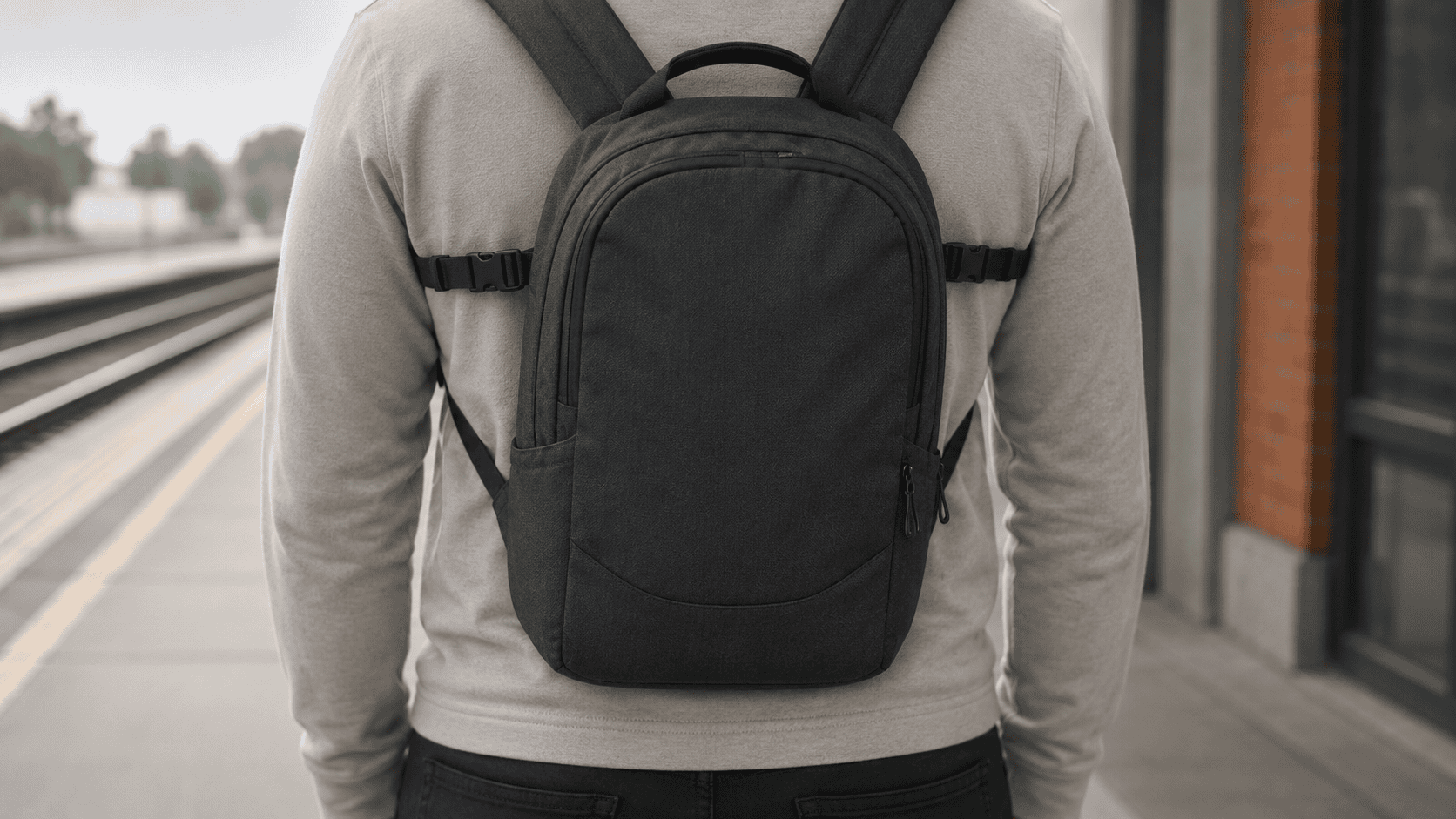
None of this requires buying a new bag. That comes later, when we have lived with the adjustments for a few weeks and decided the current bag is not quite right.
The strap test
Tomorrow morning, just pay attention.
From the moment the bag goes on to the moment it lands on the desk, count every adjustment. The hitch. The shrug. The grab-and-shift. Every time a hand goes to the strap or a shoulder rolls to reposition it. Count it.
If the number is zero, the bag fits. Close this article and go live our life.
If the number is anything above zero, something is off. The strap is too thin, or too loose, or on one shoulder when it should be on two. The bag is too heavy, or sitting too low, or swinging when it should be still.
Then do one thing. Just one. Tighten the straps tonight. Clip the chest strap tomorrow. Pull three things out of the bag that have not been used this week.
The morning after, count again.
The difference shows up before the driveway ends. Not because the bag looks different. Because the weight finally landed where it belongs, and the shoulder that has been quietly absorbing every step of every commute for years finally gets a break.
See the friction. And fix it.
See the friction. And fix it.
The car smell. The dying phone. The bag that's never quite right. One overlooked commute problem each week, and the simplest fix.
Keep reading
Daily Carry
The organized backpack: how the wrong setup drains us
The other thing inside the bag we have stopped checking on. Five zones and a 90-second Sunday reset.
Daily Carry
Our Lunch Is Leaking
The container, the spill, and the fix that takes one trip to the drawer.
Mind & Commute
We've Already Used Our Best Thinking Before We Leave the House
The morning version of decision fatigue and the night-before fix.
Mind & Commute
Monday Blues and the Region Beta Paradox
Why we tolerate the small daily friction that drains us, and never quite fix it.
Your knowledge and expertise on various topics never ceases to amaze me I always learn something new with each post
Thanks Jeffrey!