Daily Carry
Work Bag Essentials: What We Actually Carry Every Day
Most work bags are heavy for the same reason. They carry everything we might need, instead of the few things we use every single day.
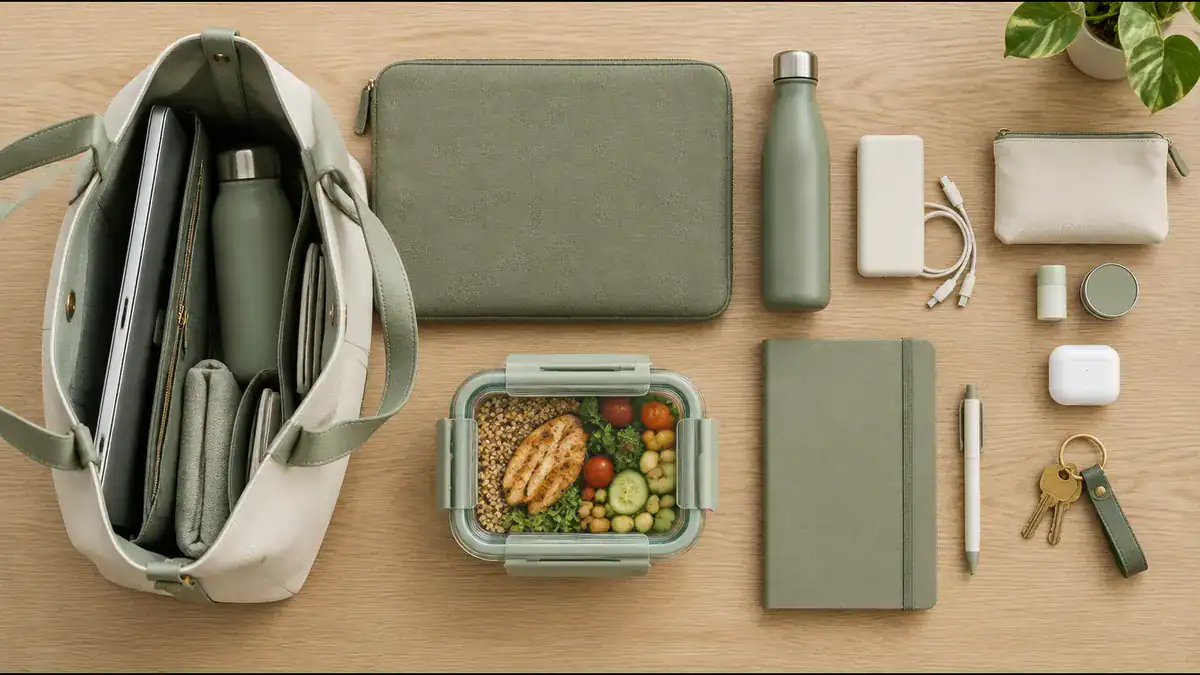
The short answer: the work bag essentials worth carrying every day are a small power bank and short cable, a leak-proof water bottle, a lunch container that actually seals, a tech pouch for chargers and earbuds, and a small personal pouch with the basics: lip balm, pain reliever, hand sanitizer, tissues, a bandage and a stain wipe. Add a compact umbrella in wet months. Everything else is optional, and most of it makes the bag heavier without making the day easier.
Open a “what’s in my work bag” post and count the items. Twenty, thirty, sometimes more. Three lip balms. Two chargers. A full-size umbrella, a book that never gets opened, a mystery receipt from August.
We understand the instinct. A work bag is the one thing we carry between home and the office, and every item in it feels like insurance. But insurance has a cost. Every extra item adds weight to the shoulder, time to every search for keys, and a little more friction to a part of the day that should take no thought at all.
So this is a short list on purpose. It is built from the problems that keep coming up on real commutes, and it stops where usefulness stops.
The core five: the work bag essentials we use every day
1. A small power bank and a short cable. The commute is where phone batteries go to die: weak signal underground, navigation, a bright screen. We covered why our phone battery drains so fast in detail. The fix that ends the 20 percent panic is a small bank that never leaves the bag, like the Anker Nano 10,000mAh with its built-in cable. Two honest notes from independent testing: like every power bank, it delivers noticeably less than its rated capacity once conversion losses are counted, and the built-in cable is better treated as a cable than as a carry handle.
2. A water bottle that doesn’t leak sideways. Most bottles are designed to stand upright in a car or on a desk. A work bag lays them down. We compared bottles for exactly this in the best water bottle for commuting, and the Owala FreeSip was the pick for bags. When owners report leaks, the usual cause is a gasket that isn’t seated or a lid that isn’t fully locked, so the one habit that matters is pressing the lid until it clicks and engaging the lock before it goes in the bag.
3. A lunch container that actually seals. A leaking lunch is the fastest way to ruin a bag and everything in it. A latching container like Rubbermaid Brilliance holds when the bag tips. More on why containers fail in our guide to leak-proof lunch containers.
4. A tech pouch. One zip pouch for every cable, charger and earbud case, so they stop tangling at the bottom of the bag. More below.
5. A personal kit pouch. The small things that rescue a workday. Also below.
The core picks
Power
Anker Nano Power Bank (10,000mAh)
A built-in USB-C cable means there is nothing extra to forget. Small enough to live in a side pocket.
For the commute that ends at 20 percent.
Water
Owala FreeSip 24 oz
A locking lid that holds when the bag lies flat, as long as it is clicked shut and locked.
For bags that get tossed on seats and floors.
Lunch
Rubbermaid Brilliance Containers
Latching lids and a silicone seal that stays tight in a moving bag.
For anyone who has found curry on a charger cable.
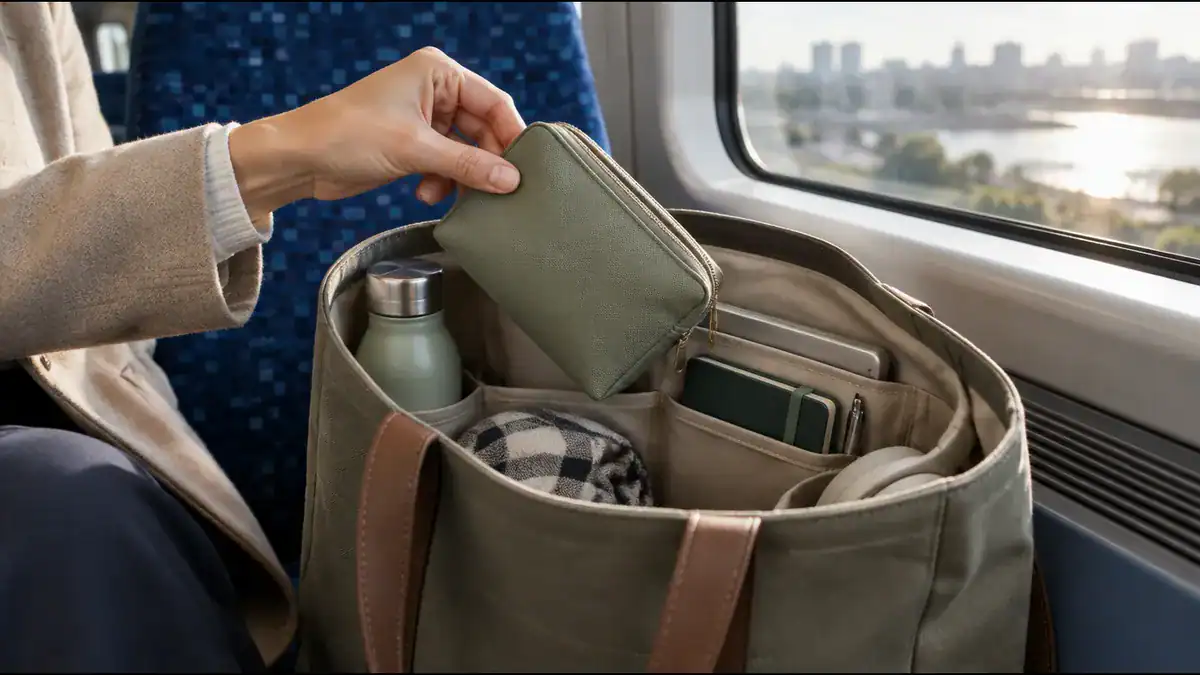
The two-pouch system: how a work bag stays organized
Most bags don’t get messy because of the big items. They get messy because of the small ones: a loose cable, a lip balm, a hair tie, a pen. Small items migrate to the bottom, and every search for keys becomes a dig.
The fix is two pouches with two jobs. When everything small lives in one of them, the main compartment holds only big things, and big things are easy to find. It is the same zone idea behind how we organize a backpack.
The tech pouch. A padded zip pouch like this BAGSMART organizer holds the charger brick, a short USB-C cable, earbuds, and a spare cable for the laptop. If the power bank doesn’t fit a side pocket, it goes here too.
The personal kit pouch. A small mesh or clear pouch, like these mini mesh pouches, so we can see what’s inside without unzipping. What belongs in it:
- Lip balm and a small hand cream
- Pain reliever, in its original labeled packaging
- Hand sanitizer and a few tissues
- Two bandages and a stain-removing wipe
- Mints or gum
- A hair tie and a couple of safety pins
- A pen that works
That’s it. If something hasn’t come out of the pouch in a month, it comes out of the bag.
The day-saver layer: weather and the unexpected
Some essentials only earn their place in certain months. We rotate them instead of carrying them all year.
A compact umbrella, in wet seasons. Small enough to forget it’s there, strong enough not to flip on the first gust. The Repel windproof travel umbrella is the widely recommended compact pick, with flexible fiberglass ribs, automatic open and close, and a lifetime warranty.
A light layer, in cold or over-air-conditioned offices. A thin packable layer weighs almost nothing and fixes the office that runs at 66 degrees in July.
A spare mask, a phone stand, a snack. Each one is useful to someone. None of them belongs in every bag. This is the layer where we are honest about our own day instead of copying someone else’s list.
The bag itself: tote, backpack and weight
Tote or backpack? A tote looks sharper and is easier to dip into. A backpack spreads the weight across both shoulders. If the commute involves a long walk, stairs or a bike, a backpack is kinder to the body, and we covered the options in the best commuter backpacks. If it is mostly car to desk, a tote is fine.
If it’s a tote, add structure. Most totes are one open cavity, which is why things sink. A felt organizer insert like this ZTUJO tote insert adds pockets and helps the bag keep its shape.
Watch the weight. The heavier the bag, the more our shoulders compensate with that constant hitch-and-shrug we described in the bag strap problem. A short list is not just tidier. It is lighter, and lighter is the whole game.
The organizing picks
Tech pouch
BAGSMART Electronics Organizer
A padded zip pouch with elastic loops for cables, a charger and earbuds.
For the tangle at the bottom of the bag.
Tote structure
ZTUJO Felt Organizer Insert
Turns a single open tote into pockets and zones, and keeps the bag from slumping.
For tote carriers who dig for their keys.
Rain
Repel Windproof Travel Umbrella
Compact, auto open and close, and built to survive wind that flips cheap umbrellas.
For the wet months, rotated out in summer.
The weekly reset: ninety seconds on Sunday
Every work bag drifts. Receipts accumulate, a second charger appears, the power bank runs flat. The fix is a short weekly reset, not a big reorganization.
- Empty the main compartment onto a table.
- Bin the loose paper and anything that doesn’t belong to a zone.
- Charge the power bank and refill the personal kit pouch.
- Wash the lunch container gasket and the bottle lid.
- Put everything back in its pouch. Done.
It takes about as long as making coffee, and Monday morning starts with a bag that already knows where everything is.
Carry smarter. Commute better.
Common questions about work bag essentials
What are the essentials to keep in a work bag?
A power bank and short cable, a leak-proof water bottle, a lunch container that seals, a tech pouch for chargers and earbuds, and a small personal pouch with lip balm, pain reliever, hand sanitizer, tissues, a bandage and a stain wipe. Add a compact umbrella in wet seasons.
What should be in a work bag for women?
The same core list works for everyone: charging, water, lunch and two small pouches. Many people add personal care items to the kit pouch, such as hand cream, a hair tie, period products and a small mirror. The key is keeping small items in pouches so the bag stays organized.
How do we keep a work bag organized?
Use two pouches: one for tech and one for personal items. With every small item in a pouch, the main compartment only holds big things like a laptop, lunch and water bottle, which are easy to find. A ninety-second reset once a week keeps it that way.
Is a tote or a backpack better for work?
A backpack is better for long walks, stairs, biking or heavy loads because it spreads weight across both shoulders. A tote is fine for short car-to-desk commutes and looks more polished. Adding an organizer insert helps a tote keep its shape and stay organized.
How heavy should a work bag be?
As light as the day allows. Extra weight shows up as shoulder and neck strain, especially with one-shoulder bags. A short essentials list, rotating seasonal items in and out, and a weekly clear-out are the simplest ways to keep weight down.
What tech should be in a work bag?
A small power bank, a short USB-C cable, earbuds and a laptop charger if the office doesn’t have one. Keeping them together in one padded tech pouch prevents tangles and makes it obvious when something is missing.
How often should we clean out a work bag?
A quick reset once a week, such as Sunday evening: empty the bag, throw out loose paper, recharge the power bank, refill the personal pouch and wash the lunch container and bottle lid.
Life on the go should be easier.
One overlooked commute problem each week, and the simplest fix.
Keep reading
Daily Carry
Our Bag Is Lying to Us
The cognitive cost of a messy bag, and the 90-second Sunday habit that fixes the whole week.
Daily Carry
The Best Water Bottle for Commuting
Why the bottle we bought for the trail is the wrong one for the train.
Daily Carry
Leak-Proof Lunch Containers
Why ours fail in a commuter bag, and the designs that actually hold.
Daily Carry
Why Our Phone Battery Drains So Fast
The causes we overlook, and the backup that ends the 20% panic.