City Commute
The Best E-Bike Lock: Why a $300 Lock Protects a $2,000 Commute
We research the e-bike. Take the test rides. Stretch the budget. The lock? Whatever’s left over. We’ve got that backwards.

“I’m sure it’ll be fine.”
We’ve spent weeks choosing the e-bike. Compared prices. Read reviews. Taken the test rides. The hill on the way to work? Suddenly nothing. The subway pass is sitting in a drawer.
Then we leave the whole thing outside the office with the cable lock that came free at checkout.
Well, it came with the bike. Surely it’s enough?
Usually, the bike’s still there when we come back. Until one evening it isn’t. And now we’re standing by an empty rack, wondering why the lock got so little thought.
The short answer: the best e-bike lock is a U-lock (D-lock) rated Sold Secure Diamond, ideally one built to resist an angle grinder, such as the Hiplok D1000 or the lighter Litelok X1. On a tighter budget, the OnGuard Pitbull STD carries the same Diamond rating for under $100. Lock the frame to something that cannot move. Take the battery inside if it comes out. Leaving the bike outside all day? Add a second lock of a different type.
Our picks at a glance
Prices are approximate. Full details on each lock are further down.
The math nobody does
About 2.4 million bikes are stolen in the US every year, worth roughly $1.4 billion, according to estimates in Bike Index’s 2025 theft report.
Big numbers. Easy to read past.
But this one lands differently: 47% of theft victims said they lost their way of getting to work.
There goes tomorrow morning. The familiar route. The time we normally leave. Now it’s checking schedules, finding another way in, scrambling through the week while we figure out what comes next.
And e-bikes make this an expensive problem.
The average e-bike in the US costs around $2,158, with most landing between about $1,700 and $2,600, based on a price survey by Discerning Cyclist. They’re also easy to resell. Exactly what an organized thief is looking for.
A lock that seriously slows down a power tool costs $250 to $350. That feels like a lot for a lock. It’s also 12 to 15% of the bike, paid once, protecting the thing we depend on every day.
Would we buy a $2,000 laptop and skip the case?
With bikes, somehow, we do.
What the ratings actually mean
Strong. Heavy duty. A big number on the box.
Fine. According to whom?
One rating system is worth learning: Sold Secure, an independent UK testing body whose ratings run Bronze, Silver, Gold and Diamond.
Bronze and Silver stop opportunists. Gold resists a range of attacks lasting around five minutes. Diamond is built for long, determined attacks in high-risk spots like public racks, as BikeRadar’s breakdown of the ratings explains.
For an e-bike left on a city street, we’re looking for Diamond.
Sold Secure ratings, lowest to highest. Check the rating for powered cycles.
There’s a catch, though. Sold Secure rates pedal bikes and powered cycles separately. A lock can be Diamond for a regular bike and only Gold for an e-bike.
Same lock. Different rating. We need to check the powered rating before buying.
Then there’s the battery-powered angle grinder. Cheap. Quiet enough on a busy street. Able to cut through most ordinary steel locks quickly.
Which is why the newer locks built to resist them deserve a closer look.
In independent testing by The Best Bike Lock, a full street-style attack on the Litelok X1 took 24 minutes and two grinder batteries. The Hiplok D1000 held for close to six minutes while burning through six cutting discs.
Angle grinder street test
How long each lock held out
The Litelok X1 took two grinder batteries. The Hiplok D1000 went through six cutting discs.
Source: The Best Bike Lock, 2026 tests
Theft-proof? No. We’re trying to make the bike take too long to steal, especially beside one that doesn’t.
As for the free cable lock? Keep it for a coffee stop where we can see the bike through the window. Never leave an e-bike with only a cable.
The locks worth carrying
These picks are based on published lock testing, Sold Secure ratings and how each lock fits a daily city ride.
Because we still have to carry the thing.
A lock can look perfect on the product page and feel considerably less perfect in the bag every morning. Heavy. Awkward. One more thing pressing into our back.
The lock we actually bring matters more than the one we leave by the door.
The everyday lock
Best overall
Hiplok D1000
A compact Diamond-rated U-lock with a shackle built to fight angle grinders. About 1.9 kg and around $330. The small opening means locking to thin poles or rails, not wide posts.
For the e-bike left on a public rack all day.
Lighter
Litelok X1
Diamond rated, about 1.7 kg and around $260. The strongest result in street-style grinder testing for its weight, and easier to carry every day.
For riders who will not carry a heavy lock.
Budget
OnGuard Pitbull STD
A Diamond-rated U-lock for well under $100, with a roomier opening. Heavier and less resistant to grinders than the two above.
For a lower-risk spot, or a first real lock.
Two more locks solve problems a single U-lock cannot. Worth considering when one U-lock doesn’t quite cover how we leave the bike.
The second layer
Home and long stays
Kryptonite New York Fahgettaboudit Chain 1415
A Diamond-rated chain with six-sided links that resist cutting, around $150. At roughly 7 kg it stays where the bike sleeps, not in the bag.
For the hallway, garage or bike room.
Alarm
ABUS SmartX 770A
A Gold-rated U-lock with a 100dB alarm that goes off when someone tampers with it, around $280. Pricey for its rating, but noise is a real deterrent.
For racks where people are around to hear it.
Carrying a two-kilo lock changes how the bag feels, too. Already arriving with a sore shoulder? Adding more weight deserves some thought.
It’s worth reading about backpack back pain and mounting the lock on the frame instead, or choosing one of the commuter backpacks built to spread the load.
We’ve fixed the hill. No need to create another annoyance for the trip.
How to lock it so the lock can do its job
We can buy a great lock and still lock the bike badly.
Wrong part of the bike. Wrong thing to attach it to. Too much space inside the lock. A quick job because we’re late.
The small details matter here.
Start with the frame. Lock it to something that cannot move: a proper bike rack, a thick steel pole that’s bolted down, a rail that’s welded in place.
A small tree? No. A sign that lifts off its post? Also no. A wooden fence isn’t the answer either.
We need to look at what’s holding the bike, not just whether the lock clicks shut.
Keep it low and tight. Fill the inside of the U-lock with frame and rack so there’s no room for a jack or a bar. Keep the lock off the ground, where it’s easier to smash or lever.
Low doesn’t mean resting on the pavement.

Take the battery and display when we can. If the battery comes out, it’s often the most expensive single part on the bike. Bringing it inside also makes the bike useless to anyone who rides off with it.
Another thing to carry? Yes. An expensive thing to leave behind? Also yes.
For long stays, use two different locks. A U-lock plus a chain means a thief needs two kinds of tools and twice the time. Most will simply move on to an easier bike.
And then there’s home.
The garage. The patio. The shared bike room. Places where locking up can feel unnecessary because, well, we’re home.
According to the same Bike Index report, 59% of thefts happen in residential areas, often from garages, patios and shared bike rooms where nobody bothered with a lock.
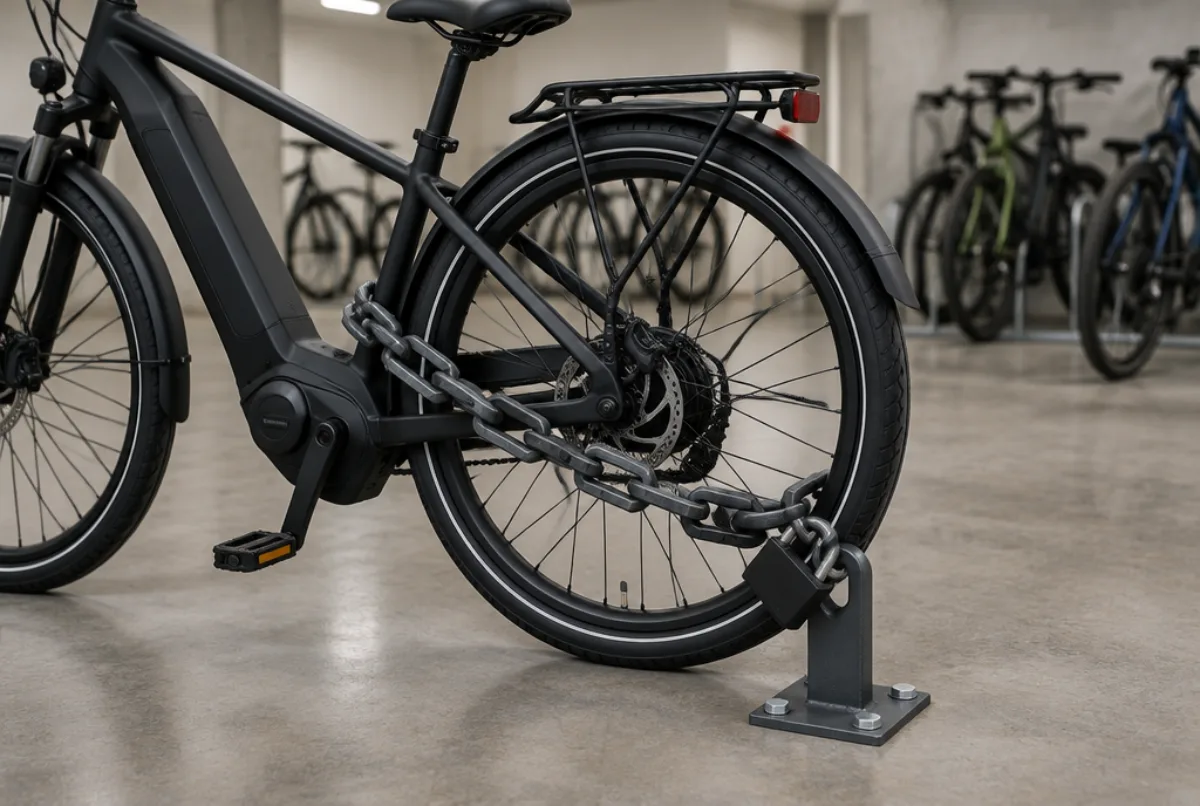
So we lock it there, too.
The 30-second lock check
Before walking away from the bike
None of it costs extra. All of it buys time.
Register it, track it, insure it
Even after all that, a lock lowers the odds. It doesn’t erase them.
There are a few boring jobs worth doing before we need them. Preferably while the bike is still sitting in front of us.
Write down the serial number, usually stamped under the bottom bracket. Register the bike for free with Bike Index.
It’s easy to put this off. We’ve got the bike. We’ve got somewhere to be. Who wants to stop and write down a number?
But registered bikes are far easier to prove are ours when they turn up for sale. That number gets a lot more interesting once the bike is missing.
Hide a tracker, too. An AirTag or similar tracker tucked inside the frame, under the seat or in a light mount can show where the bike went.
Thieves increasingly check the obvious spots. So the hiding part matters.
Then check insurance. Many e-bike policies cover theft only if the bike was locked with an approved lock, often Gold or Diamond rated.
Better to read that requirement now than discover it while reporting a theft.
Some lock makers, including Kryptonite and OnGuard, offer their own theft protection if we register the lock after buying it. Nice to have. But it’s a bonus, not a reason to pick one lock over another.
None of this is the fun part of getting an e-bike.
The fun was the first ride. Getting up the hill without the usual struggle. A faster, cheaper commute that maybe felt a little joyful again.
We’d like to keep doing that.
Including on an ordinary Tuesday evening, when we leave the office, turn the corner and expect the bike to be there.
Carry smarter. Commute better.
Common questions about e-bike locks
What is the best lock for an e-bike?
We’d start with a U-lock (D-lock) rated Sold Secure Diamond, ideally one designed to resist angle grinders, such as the Hiplok D1000 or Litelok X1. Tighter budget? The OnGuard Pitbull STD is Diamond rated for under $100. For long stays outside, we’d add a second lock of a different type.
Are cable locks safe for e-bikes?
No. Cable locks can be cut in seconds with basic tools. A quick stop where we can see the bike? Fine. An extra layer to secure a wheel? Also fine. But we should never leave an e-bike with only a cable lock.
What does Sold Secure Diamond mean?
Sold Secure is an independent testing body that rates locks Bronze, Silver, Gold and Diamond. Diamond is the highest level, meant to resist long, determined attacks in high-risk places like public racks. One detail we need to check: the powered cycle rating. Some locks rate lower for e-bikes than for regular bikes.
Can any bike lock stop an angle grinder?
No lock is fully angle grinder proof. Some just hold out far longer. In independent street-style testing, the Litelok X1 took 24 minutes and two grinder batteries to defeat, and the Hiplok D1000 held for nearly six minutes. We’re trying to make the job take too long. Most thieves give up and move to an easier bike.
Should I take the battery off my e-bike when I lock it?
If it comes out, yes. It’s often the most expensive single part of the bike. Another thing to bring inside, sure. But taking it with us also makes the bike much less useful to a thief.
Life on the go should be easier.
One overlooked commute problem each week, and the simplest fix.
Keep reading
City Commute
The Noise You’ve Stopped Hearing Is Still Draining You
The city commute sound we tune out, and what it quietly costs us.
Daily Carry
The Best Commuter Backpacks of 2026
Find the bag for how we actually get to work.
Daily Carry
Backpack Back Pain
The daily strain we’ve stopped noticing, and the fixes that hold up.
Mind & Commute
Why Delays Stress Us More Than Long Commutes
The unpredictability that makes a short trip feel worse than a long one.