Daily Carry
The best water bottle for commuting is not the one we bought for the trail
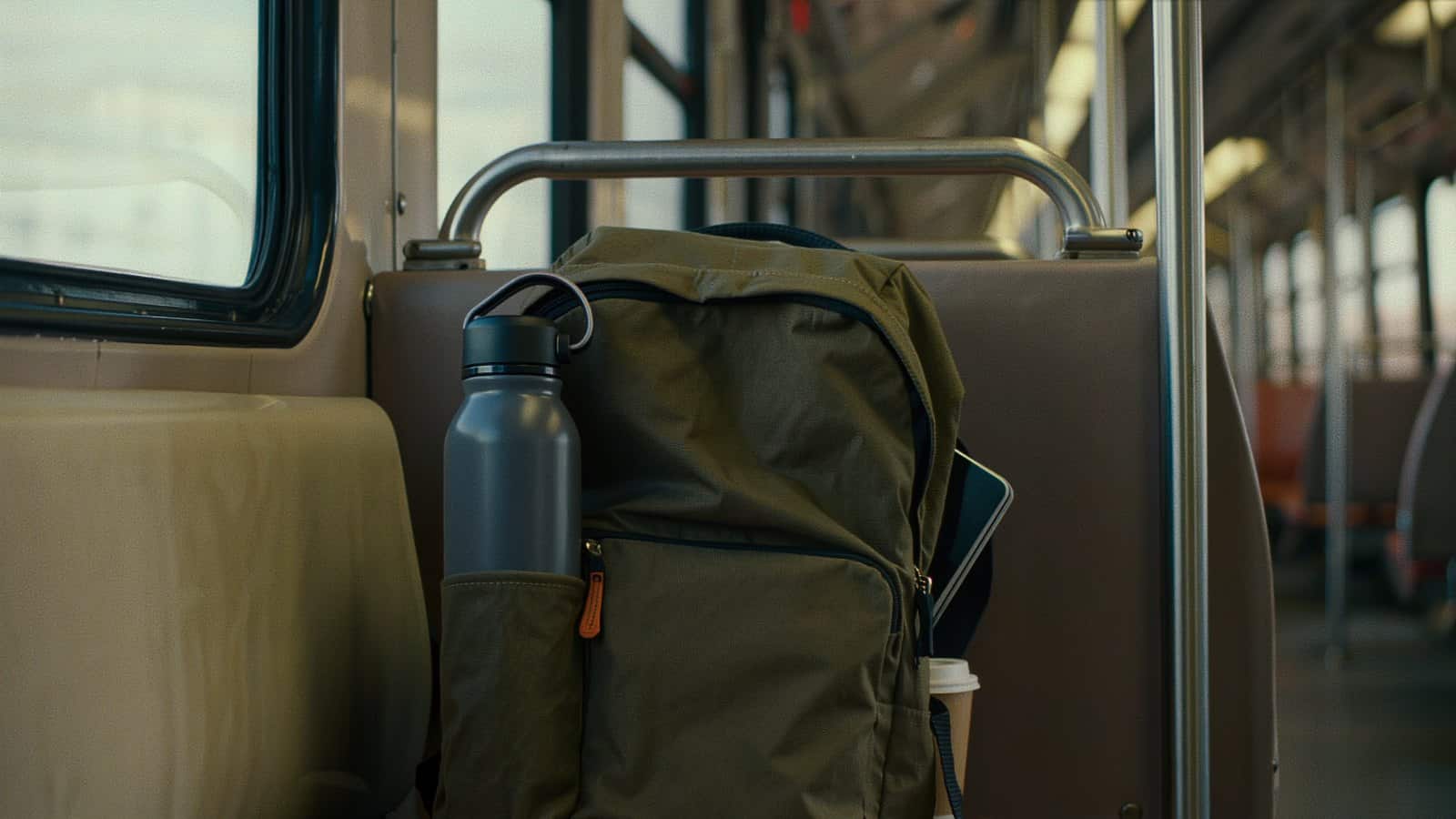
Affiliate disclosure: this article contains affiliate links to products. As an Amazon Associate, CarryCommute earns from qualifying purchases. We may earn a small commission if a reader buys through these links, at no extra cost. Every bottle here was checked against the brand’s published specifications, hands-on testing from independent outlets, and current customer feedback. No money or product samples were accepted in exchange for placement. Full disclosure policy →
“Why is the bottom of my bag wet?”
It’s a Tuesday. We reach into the bag for the laptop and the sleeve is cool and damp along one edge. Not soaked. Just damp enough to notice, damp enough to wonder, damp enough to spend the first ten minutes at the desk checking whether the charger port still works.
The bottle is fine. It’s a very good bottle, actually. We chose it carefully, after an evening of reading about insulation and dent resistance and how many hours it keeps ice frozen on a mountain. Ours has been on zero mountains. It has been on something like 340 train rides, and it was bought for a camping trip that got rained out.
On every one of those rides it has been lying on its side, wedged against a laptop, doing a job nobody designed it for.
The best water bottle for commuting is not the best water bottle. It is the one that passes four tests the trail bottle never had to face: it cannot leak when it lies sideways in a bag for forty minutes, it cannot sweat against a laptop, it has to fit a cup holder or a side pocket, and it has to be light enough that we carry it every single day instead of most days. Most bottles, including some of the most loved ones, fail at least one.
None of this is complicated. The bottle aisle is just organized around hiking and the gym, and we shop it as if the commute were one of those. It isn’t. Nobody has ever needed 64 ounces between the front door and the office. The damp laptop is a region beta problem: annoying enough to notice every week, never quite annoying enough to fix.
Quick start
If we only read one table
Picks by commute type. The reasoning, the measurements, and the caveats are below.
| If we commute by ___ | The bottle | Why this one |
|---|---|---|
| Car | Hydro Flask 24 oz Standard Mouth | 2.85 in base fits almost every cup holder; screw cap, no straw to leak See the car pick |
| Train, subway, or on foot | Owala FreeSip 24 oz or YETI Rambler 18 oz | Both sit sideways in a bag without sweating; Owala for a straw, YETI for fewer parts See the bag picks |
| Anything, and the bag is already heavy | YETI Yonder 25 oz | About 0.6 lb empty, leakproof tether cap, no insulation See the light pick |
| The desk (the bottle that never leaves) | Nalgene 32 oz Wide Mouth | Cheap, light, indestructible, and it removes the “did I pack it” question See the desk pick |
If there is one idea behind every pick on this page it’s this: a commute bottle spends most of its life horizontal, pressed against electronics, in a space measured in inches. A trail bottle spends its life upright, in a bottle cage or a hand. Almost everything below follows from that one difference.
A commute bottle spends most of its life horizontal, pressed against electronics, in a space measured in inches.
Why the trail bottle fails the commute
Walk into any store and the water bottle wall is a monument to a life most of us don’t live. Sixty-four ounce growlers. Forty ounce tumblers with handles. Bottles rated by how many hours ice survives inside them, as if we were going to be away from a tap until Thursday. We stood in front of that wall for twenty minutes once and left with the wrong thing, which is probably how everyone does it.
The commute is forty minutes. Maybe an hour. There is a kitchen at one end and a kitchen at the other. The bottle is not the water supply. It is the thing that makes drinking water on the way as easy as not drinking it.
That reframing changes what matters. Insulation still matters, but it matters for a different reason than the marketing suggests: a vacuum wall is what keeps cold water from sweating on the outside, and a bottle that doesn’t sweat is a bottle that can live next to a laptop. Capacity matters less than we think. Weight matters more than we think, because a full 32 oz steel bottle is close to three pounds on one shoulder, every day, both directions.
And the lid matters most of all, because the lid is where a bottle leaks, and the commute is the only part of the day when the bottle is lying down.
What a dry morning actually does to us
Worth being precise here, because the hydration industry mostly isn’t.
We do start the day a little behind. Perrier and colleagues (2013, European Journal of Applied Physiology) tracked 52 young adults over five days and found the overnight and first-morning urine collections were significantly more concentrated than afternoon samples. That is what seven hours without drinking would predict. No study has put a precise body mass figure on it for ordinary adults, so “we wake up dehydrated” is true in direction and unmeasured in size.
Across the whole day the numbers are clearer. Chang and colleagues (2016, Annals of Family Medicine) analyzed 9,528 US adults in NHANES 2009 to 2012 and found 32.6 percent were inadequately hydrated by urine osmolality. Roughly one in three of the people on the train.
What does mild dehydration do? Less than the headlines say, and more than nothing. Ganio and colleagues (2011, British Journal of Nutrition) dehydrated 26 young men by about 1.6 percent of body mass and saw more errors on a vigilance task and slower working memory, along with higher fatigue and tension. Reaction time, learning, and reasoning were unaffected. Armstrong and colleagues (2012, Journal of Nutrition) ran the parallel study in 25 young women at about 1.4 percent and found the strongest signal was mood: more fatigue, less vigor, headaches, and a feeling that tasks were harder. Most of the objective cognitive scores didn’t move.
The 2018 meta-analysis by Wittbrodt and Millard-Stafford (Medicine & Science in Sports & Exercise) pooled 33 studies and 413 participants: attention took the biggest hit (effect size -0.52), then motor coordination (-0.40), then executive function (-0.24). Simple reaction time barely moved. And the impairment was significantly larger above 2 percent body mass loss than below it.
So the honest summary is this. A commuter who hasn’t had water since last night is probably not measurably slower. They are a little more tired, a little more irritable, a little more likely to find the morning’s first problem harder than it is. Which is a fair description of most of us at 8:40 a.m., and which is exactly the kind of low-grade drag that stacks with everything else we’ve already spent before the desk.
Where the research runs out
No study has measured whether commuters specifically drink more water when they carry a bottle than when they don’t. The adjacent literature on cues and access (water fountains in schools, drink visibility in cafeterias) points that way, but the most-cited “convenience drives consumption” work came from a lab whose findings were retracted after a misconduct investigation, so we are not going to lean on it. Treat “a bottle in reach means more water” as a reasonable bet, not a finding.
One more thing the coffee people will want to know. Killer, Blannin and Jeukendrup (2014, PLOS ONE) had 50 habitual male coffee drinkers spend three days on four 200 ml coffees a day and three days on the same volume of water. Total body water and urine output were the same either way. For a regular drinker, the morning coffee counts. The study didn’t test women, occasional drinkers, or big doses, so it is a narrower finding than it sounds. But the bottle and the coffee are not in competition.
The four commute tests
This is the part the bottle wall skips. Nobody prints “lies flat in a bag for an hour without weeping” on a hang tag, but for us that’s the spec that matters. So we wrote our own. Six things a bottle has to do before it earns a place in the bag or the cup holder.
Before the brand, before the color
Does it pass the commute?
Read across those six and something becomes obvious. The bottles that dominate the wall, the 32 oz wide mouths and the 40 oz handled tumblers, were built to win the sweat test and the cold test and nothing else. They fail the bag test, the fit test, and the carry test all at once. The ones that pass all six are the medium bottles, 18 to 24 oz, with a proper lid. That’s a smaller category than the aisle suggests, and a cheaper one, which is probably why the aisle doesn’t suggest it.
We can’t quote the threads directly, but we can see which ones people actually land on. Google’s top results for the most-searched bottle questions are, over and over, Reddit threads with the commuter’s problem right in the title. Here is a sample.
Where the searches land
What commuters are asking Reddit
r/BuyItForLife
Insulated water bottle that fits cup holders
Top Google result for “water bottle that fits in cup holder”
r/YetiCoolers
Rambler water bottles that fit in standard car cup holders
Second result for “yeti rambler cup holder”
r/Crosstrek
Will a 32 oz Owala bottle fit in the cup holder?
Top result for “does 32 oz owala fit in cup holder”
r/YetiCoolers
Are YETI Ramblers really 100% leak proof?
Alongside an r/BuyItForLife thread titled “Yeti leaks, do not buy”
r/BuyItForLife
A water bottle that doesn’t sweat
A request thread that keeps ranking for “no sweat water bottle”
r/onebag
Solutions to backpacks not having external water bottle pockets
Second result for “water bottle holder for backpack”
r/backpacks
Simple laptop backpack that can hold a large water bottle
Top result for “laptop backpack with water bottle holder”
Fit, leaks, sweat, and where to put it. The same four tests, asked from the other side.
The fit problem, measured
The fit test deserves its own numbers, because this is where the most expensive mistakes happen. Cup holders in most cars fall somewhere between roughly 2.8 and 3.5 inches across, and a backpack side pocket is cut for a similar range, so a water bottle for a backpack side pocket obeys the same number. The bottle’s base width decides everything, and it is almost never on the box.
Base width, from each brand’s own spec sheet
Who fits the cup holder
Orange: fits nearly every holder and pocket · Grey: at or past the edge of a typical holder · Scale ends at 4 in
The most useful line on that chart is the YETI Rambler 26 oz. It’s one of the most popular insulated bottles in the country, and YETI’s own product page says it may not fit in most vehicle cup holders. That isn’t a knock on the bottle, which is excellent. It’s a knock on buying it for a car commute, which a great many people do, and then spending three years listening to it roll around the passenger footwell on every left turn.
The Owala FreeSip is missing from the chart because Owala doesn’t publish a base diameter we could verify. The pattern from owners is consistent, though: the 24 oz fits standard holders, the 32 and 40 oz generally don’t, which is why “Will a 32 oz Owala bottle fit in the cup holder?” is a whole thread on a Subaru forum. If the car has a narrow holder, the 24 is the Owala to buy.
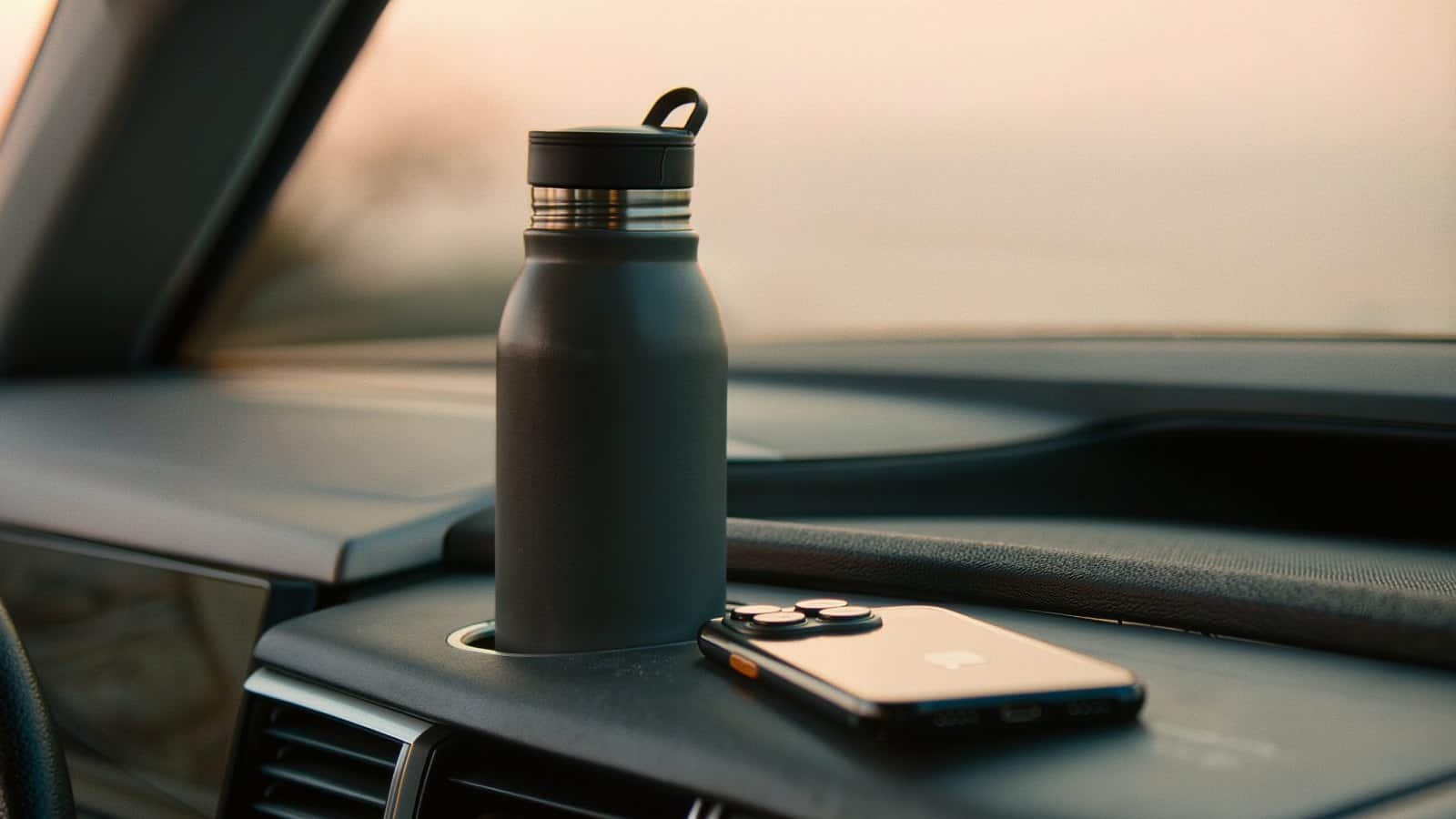
For the car commute: the one that actually fits
The car commute has one hard constraint and one soft one. The hard one is the cup holder. The soft one is that the bottle gets opened at red lights, with one hand, without looking, so the lid has to be simple. A straw is nice here. A screw cap is fine. A wide mouth with an open rim is a lap full of water at the first hard brake.
The pick is the narrowest mainstream insulated bottle that still holds a real amount of water.
The car pick
Hydro Flask 24 oz Standard Mouth
For any car, including the ones with the narrow holders
At 2.85 inches across the base, this is the bottle that fits the holder in the compact car, the older sedan, and the rental. Nothing else in the mainstream insulated category is narrower. The Flex Cap is a plain screw lid with a strap, which means it passes the bag test too on the days the car commute turns into a train commute. Vacuum insulated, so it doesn’t sweat into the console. Hydro Flask lists it as dishwasher safe.
The trade: the standard mouth is narrow. Ice cubes have to be small, and OutdoorGearLab’s testers found it harder to clean thoroughly than a wide mouth. The height is also the tallest in this article, which is fine in a cup holder and a little much in a slim side pocket. Paint nicks with use; the insulation underneath doesn’t care.
Buy it
Hydro Flask 24 oz Standard Mouth with Flex Cap
Narrowest base in the category · vacuum insulated · dishwasher safe
Get the Flex Cap version for the commute, not the straw lid. The screw cap is what makes it safe to toss in a bag.
View on Amazon →Tier 3 · Spec-compared
If it has to be a YETI: the Rambler 18 oz with Chug Cap. 3.0 inches across, 10.2 inches tall, dishwasher safe, and the Chug Cap opens one-handed. Heavier (1.2 lb empty) and it holds six ounces less. Screw the cap down fully every time; a half-turned Chug Cap is the leak people report. View on Amazon →
If we want a straw and the bottle never leaves the car: the Stanley IceFlow Flip Straw Tumbler 30 oz. Stanley says the base is designed to fit most car cup holders, and the flip straw is one-handed at a red light. Stanley calls it leak resistant, not leakproof, so it stays in the holder and out of the bag. View on Amazon →
Worth knowing
The Stanley recall is not the bottle people think it is
In 2025 the CPSC announced a recall of about 2.6 million Stanley Switchback and Trigger Action travel mugs, because the lid threads could shrink and the lid could come off with hot liquid inside. The CPSC notice lists those two lines by product number. It does not cover the Quencher or the IceFlow. If a Stanley on the shelf is one of the mug lines, check the base against the notice; if it’s a Quencher or IceFlow, the recall isn’t about it.
For the bag commute: the ones that lie down without leaking
Train, subway, bus, walking. The bottle is horizontal for most of the trip, in a pocket that also holds the one thing in the bag we cannot get wet. So the lid is the whole decision, and there are two good answers depending on how we like to drink.
If a straw makes us drink more (for a lot of people it does, and there’s no shame in it), the Owala FreeSip is the bottle that made straw lids safe to carry, with one condition attached. If we’d rather have a lid with nothing to lock and nothing to disassemble, the YETI Rambler 18 oz is the simpler machine.
The bag pick, straw version
Owala FreeSip 24 oz
For the train and the walk, if we lock it every time
The FreeSip lid does two things at once: a built-in straw for sipping upright and an open spout for tipping it back. Both sit under a flip cap with a lock, and the lock is the reason this bottle can go in a bag at all. CNN Underscored’s testers specifically called out the locking mechanism for keeping the cap from popping open, and named it their favorite straw bottle. Vacuum insulated, so it doesn’t sweat. The 24 oz is the size that fits cup holders.
The condition: the lid is also the most-discussed weak point. The Owala subreddit has threads titled “Leaky” and “Is this bottle really leakproof?”, and the first is the top Google result for “does owala leak.” An aggregate of r/BuyItForLife and r/HydroHomies discussion compiled by RedRecs (which we could not verify comment by comment) rates the FreeSip well overall and names the lid mechanism as the place it fails when it fails. In practice that means two habits: lock it before it goes in the bag, every time, and take the straw and spout apart to wash them weekly. There are more channels in this lid than in a screw cap, and water that sits in them is where the mold complaints come from. It isn’t a defect. It’s a straw.
Buy it
Owala FreeSip 24 oz
Locking flip lid · straw and spout · vacuum insulated · dishwasher safe (top rack)
Buy the 24, not the 32 or 40, for anything that has to fit a cup holder or a side pocket. Lock it before it goes in the bag. Wash the lid on Sundays. That’s more or less the whole manual.
View on Amazon →Tier 2 · Community-sourced
The bag pick, no-straw version
YETI Rambler 18 oz with Chug Cap
For the commuter who drops things on platforms and doesn’t want to think about a lid
The Chug Cap is a screw-on outer cap over a narrow spout: unscrew the top, drink, screw it back. Two parts, no straw, no channels, and the whole thing goes in the dishwasher. This is the bottle with the strongest reputation for surviving drops; the same Reddit aggregate ranks the Rambler first for durability and the recurring complaint is that it is heavy and expensive, both of which are true. At 3.0 inches across and just over ten inches tall it fits side pockets and cup holders, which the 26 oz does not.
The trade: 1.2 lb empty is the top of what we’d call carryable, and 18 oz is a commute plus a couple of hours, not a whole day. That’s fine. There is a tap at work. The other thing to know is that the Chug Cap has to be screwed fully home. There is an r/YetiCoolers thread titled “Are YETI Ramblers really 100% leak proof?” and an r/BuyItForLife one titled “Yeti leaks, do not buy”; a cap left a half-turn loose is where most of those stories come from, and it’s a habit problem more than a bottle problem.
Buy it
YETI Rambler 18 oz Bottle with Chug Cap
Two-part screw cap · vacuum insulated · dishwasher safe · fits cup holders
The 18, not the 26. Same bottle, same cap, a base that actually fits where a commuter needs it to.
View on Amazon →Tier 2 · Community-sourced
The lighter steel alternative: Klean Kanteen TKWide 20 oz with the Twist Cap. Steel threads instead of plastic, 3.0 inches across, about 0.9 lb empty, and Klean claims 59 hours iced. Fewer people carry it, so there is less owner feedback to go on, but the specs are the best fit-to-weight ratio in insulated steel. View on Amazon →
The lightest carry, and what it costs
Some commutes are already at the limit. The bag has the laptop, the charger, the lunch, the shoes for the office, and the three things we’ve been meaning to take out for a month. Adding a pound of steel is the reason the bottle stays on the counter.
For that commute, insulation is a luxury we can skip. The trade is honest and worth spelling out: a plastic bottle full of ice water will sweat, so it either carries room-temperature water or it rides in the outside pocket, not against the laptop.
The light pick
YETI Yonder 25 oz with Tether Cap
For the overloaded bag, and for anyone who keeps leaving the heavy one at home
About half the weight of the Rambler line, by YETI’s own comparison, which is the difference between a bottle that gets packed and one that gets looked at. A BPA-free plastic body that YETI markets as leakproof, with a tether cap that can’t roll under the seat. It fits cup holders. Pack Hacker’s testers noted the flat-sided profile sits better in a backpack bottle pocket than a round steel bottle does. Dishwasher safe.
The trade: no vacuum wall, so it fails the sweat test with cold water. Room-temperature water from the tap is dry on the outside and that is how most people end up using it. It is also the tallest bottle here after the Hydro Flask, which matters in a short side pocket.
Buy it
YETI Yonder 25 oz (750 ml) with Tether Cap
About 0.6 lb empty · leakproof tether cap · not insulated
Choose the 750 ml on the listing, and the Tether Cap rather than the straw cap for anything that goes in a bag.
View on Amazon →Tier 3 · Spec-compared
The second bottle: the one that never leaves
The last fix isn’t a bottle at all. It’s two of them.
The bottle we carry is the commute bottle. Small, sealed, light. The bottle that lives at the desk is a different object with a different job: big, cheap, and permanent, so that the morning no longer depends on whether we remembered to grab the good one off the drying rack. This is choice architecture applied to a water bottle. Remove the decision and the decision stops getting made wrong.
The desk pick
Nalgene 32 oz Wide Mouth
For the desk drawer, the car door pocket, the place we keep forgetting
Under half a pound, dishwasher safe, and it has been the same bottle for decades because there was nothing to fix. The loop-top cap is tethered and cannot be lost. At the desk, none of the commute tests apply: it can sweat on a coaster, it can be wide, it can hold a quart. CNN Underscored named it their best backup bottle for the same reason.
The trade: the 3.5 inch base is at the edge of most cup holders, and the plastic picks up flavors over years. Neither matters for a bottle that stays put.
Buy it
Nalgene 32 oz Wide Mouth (Tritan Renew)
Under half a pound · tethered cap · dishwasher safe · decades of the same design
Fill it Monday from the office tap and it stays on the desk all week. The commute bottle only has to cover the commute, which is the point.
View on Amazon →Tier 2 · Community-sourced
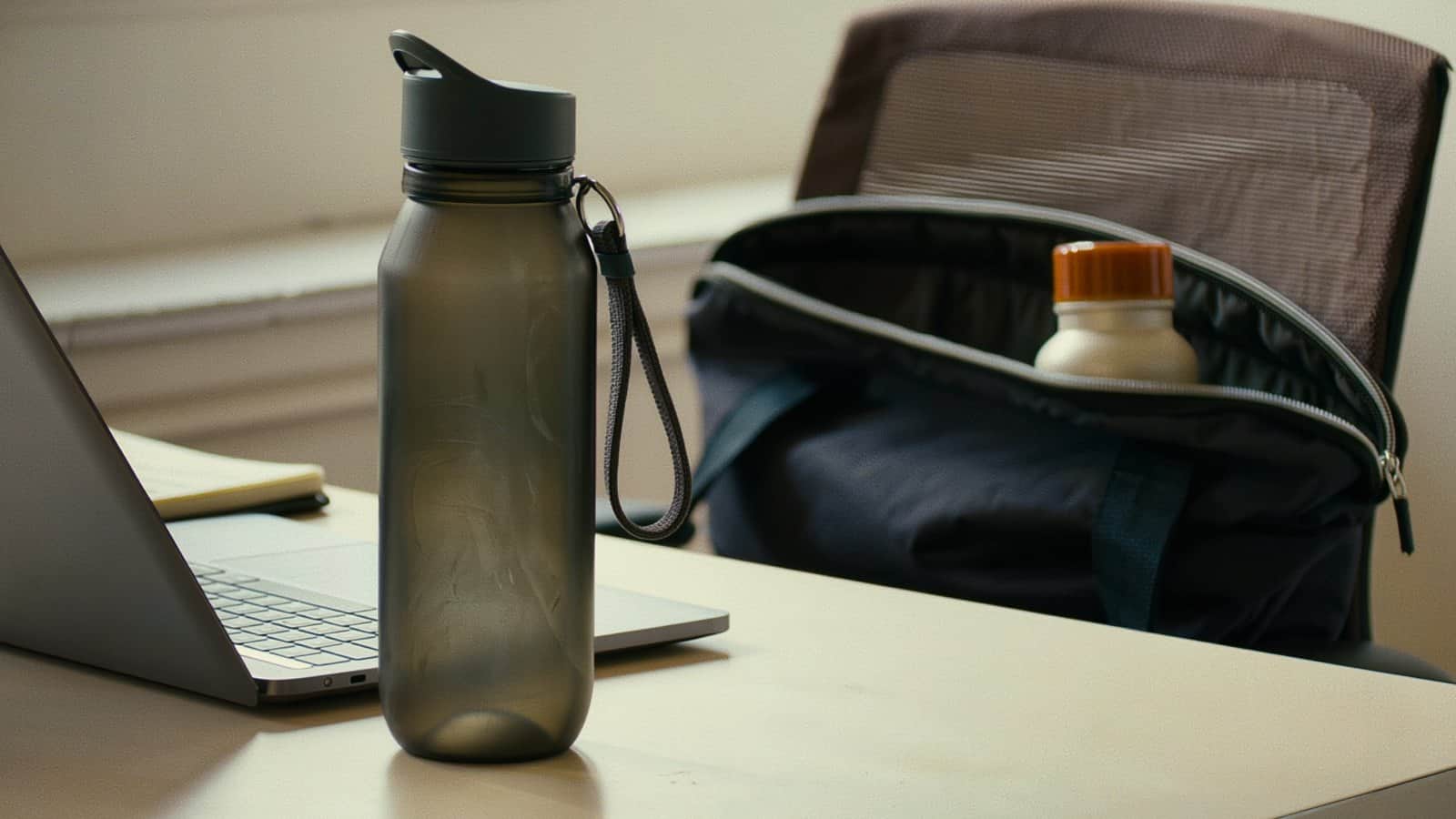
YETI vs Hydro Flask vs Owala, for the commute only
The three brands people actually compare, judged on the six tests rather than on hours of ice. Every number is from the brand’s own spec sheet.
Commute scorecard
Same category, different jobs
| Bottle | Base | Empty | Lid | Commute verdict |
|---|---|---|---|---|
| Hydro Flask 24 oz Standard | 2.85 in | 0.83 lb | Screw (Flex Cap) | Car pick. Fits every holder; narrow mouth is the only compromise. |
| YETI Rambler 18 oz | 3.0 in | 1.2 lb | Chug Cap (screw) | Bag pick, no straw. Toughest of the three; heaviest of the three. |
| YETI Rambler 26 oz | 3.4 in | 1.4 lb | Chug Cap (screw) | Skip for the car. YETI says it may not fit most cup holders. |
| Owala FreeSip 24 oz | Not published | Not published | Locking flip, straw + spout | Bag pick, straw. Lock it every time; wash the lid weekly. |
| Hydro Flask 32 oz Wide | 3.55 in | 0.97 lb | Screw or flip straw | Skip for the car. Past the edge of most holders; fine at a desk. |
Owala does not publish base width or empty weight on a spec page we could verify, so those cells are blank rather than guessed.
The pattern, again: within each brand, the smaller bottle is the commuter bottle. The brand matters less than the size, and the size matters less than the lid.
The cold question, minus the marketing
Every one of these brands prints an hour figure, and the figures are not comparable. Hydro Flask claims 24 hours cold. Stanley claims 12 hours cold and two days iced for the IceFlow. Klean Kanteen claims 59 hours iced for the TKWide. YETI doesn’t publish an hour figure for the Rambler bottle at all. Each brand runs its own test with its own starting temperature, its own ice load, and its own room, so the 59 and the 24 are not on the same scale.
Where the research runs out
We looked for a methodologically transparent independent lab comparison of the YETI Rambler, Hydro Flask, Owala FreeSip, and Stanley and did not find one. The independent testers we trust (OutdoorGearLab, CNN Underscored) describe insulation qualitatively rather than in hours and degrees. The only numeric head-to-head we found was a single-run backyard test that its own author flagged as unreliable. So we are not going to print a ranking. What we can say is that every vacuum-insulated bottle on this page keeps tap-cold water tap-cold from the kitchen to the desk, and that is the entire job.
The cold that matters on a commute isn’t the ice at hour 24. It’s the dry outer wall at minute 30, sitting against the laptop. Single-wall bottles can’t do that. Every insulated one can, and after that they’re all roughly equal for our purposes.
Making it automatic
A good bottle that stays on the counter is a paperweight, and we’ve owned a few paperweights. The last piece is getting it into the bag without having to decide to.
Lally and colleagues (2010, European Journal of Social Psychology) followed 96 volunteers who each picked one small daily behavior to repeat in the same context, and “drinking a bottle of water with lunch” was literally one of the behaviors people chose. Among the 39 participants whose data fit the model, the median time to automaticity was 66 days, with a range from 18 to 254. The headline isn’t the 66. It’s the range: some people were on autopilot in under three weeks, and some took most of a year. The consistent context was the thing that made it happen at all.
The consistent context here is the night before. The bottle gets filled and goes into the side pocket when the bag is packed, alongside the charger and the lunch, so the morning doesn’t have to remember. Gollwitzer and Sheeran’s 2006 meta-analysis of 94 studies and more than 8,000 people found that an “if this, then that” plan (if I am packing the bag, then I fill the bottle) improved follow-through with an effect size of 0.65 over simply intending to. That is across many kinds of goals, not water specifically, but the mechanism is the same one we’ve written about for the rest of the morning: decide once, at night, so 7 a.m. doesn’t have to.
The bottle gets filled when the bag gets packed. The morning doesn’t have to remember.
What to stop carrying
None of these are bad products. Several of them are excellent at the job they were built for. They are simply the wrong shape for a commute, and most of us found that out the expensive way.
Skip these for the commute
The YETI 26 oz Rambler, for a car commute
3.4 inches across, 10.9 tall, and YETI’s own page says it may not fit most vehicle cup holders. Buy the 18 for the car. Keep the 26 for the desk or the weekend.
The 40 oz handled tumbler, in a bag
An open straw and a lid that isn’t sealed. It was designed to sit upright on a desk or in a console, and a whole accessory market of cup-holder adapters exists because it tips in the ones it doesn’t fit. Fine at the desk. Never in the bag.
Any 32 oz wide mouth, for a cup holder
3.5 inches and up is where cup holders stop cooperating. The 32 oz Hydro Flask Wide Mouth is 3.55. It’s a superb desk and gym bottle and a poor passenger.
A straw lid we won’t take apart
Straw lids make some people drink more and that’s a real benefit. They also have channels where water sits. If the lid isn’t going to come apart weekly, get a screw cap. That is the honest choice, not the lazy one.
A case of single-use bottles in the trunk
Qian and colleagues (2024, PNAS) used a new imaging method on three popular brands of bottled water and counted about 240,000 plastic particles per liter, roughly 90 percent of them nanoplastics. The health meaning is still being worked out, and the study is about disposable bottled water, not reusable bottles. It is a good enough reason to stop buying the case.
The bottle we reach for
Tonight, when the bag gets packed, it’s worth pulling the bottle out and looking at it the way a commuter would rather than the way the store did.
How wide is the base. How heavy is it empty. What happens if it lies on its side for an hour. Whether it sweats. Whether it’s been staying home on the heavy days, and whether we noticed.
A lot of us will find we’ve been carrying a very good bottle for a life we don’t have, and paying for it in small installments: a damp laptop sleeve, a sore shoulder, a bottle rolling around the footwell at every turn. The lunch container had the same problem, and the fix was the same shape: the right object for the actual trip, not the aspirational one.
The commute is forty minutes, horizontal, measured in inches. It doesn’t need the mountain bottle. It never did. It needs the one that fits.
Carry smarter. Commute better.
Common questions
This article is general consumer information, not medical advice. Hydration needs vary with health, medication, climate, and activity. For personal guidance, consult a qualified medical professional.
What is the best water bottle for commuting? It depends on how we commute. For the car, the Hydro Flask 24 oz Standard Mouth, because its 2.85 inch base fits nearly every cup holder. For a bag commute, the Owala FreeSip 24 oz with the lid locked, or the YETI Rambler 18 oz with Chug Cap for fewer parts. For the lightest carry, the YETI Yonder 25 oz at about 0.6 lb, uninsulated. A commuter bottle has to pass four tests: no leaking on its side, no sweating on a laptop, a base that fits, and a weight we’ll carry daily.
Does the Owala FreeSip fit in a cup holder? The 24 oz does in most cars. The 32 oz and 40 oz generally don’t, because the base widens with capacity. If the holder is narrow, measure it: most factory cup holders fall somewhere between about 2.8 and 3.5 inches across.
Does the YETI 26 oz Rambler fit in a cup holder? Usually not. YETI’s product page says it may not fit in most vehicle cup holders; it is 3.4 inches across and 10.9 tall. The Rambler 18 oz (3.0 inches) is the YETI that fits, and the Hydro Flask 24 oz Standard Mouth (2.85 inches) fits narrower holders still.
Which Hydro Flask size fits in a cup holder? The 24 oz Standard Mouth, with a 2.85 inch base, fits nearly every car and is the narrowest mainstream insulated bottle. The 32 oz Wide Mouth is 3.55 inches, at or past the edge of most factory holders, so it is the biggest Hydro Flask that fits only in cars with generous holders. Measure the holder first.
Does the Owala FreeSip leak in a bag? With the flip lid locked, it is designed to be leakproof, and CNN Underscored’s testers praised the lock for keeping the cap shut. The lid is also the most commonly named weak point among owners: unlocked and on its side, the spout can weep. Lock it every time and wash the straw assembly weekly.
What size water bottle is best for a commute? 18 to 24 oz. A 32 oz steel bottle is close to a pound empty and about three pounds full, with a base that starts failing cup holders and slim pockets. An 18 to 24 oz bottle covers the commute and the first hours at the desk, weighs 0.8 to 1.2 lb empty, and fits. There is a tap at work.
YETI vs Hydro Flask for commuting? Hydro Flask for the car, because the 24 oz Standard Mouth has the narrowest base in the category. YETI Rambler 18 oz for a bag commute with drops and stairs, because it has the stronger durability reputation and a two-part dishwasher-safe cap. The 26 oz Rambler is the one to avoid for the car, by YETI’s own admission.
Owala vs YETI for commuting? Owala if a straw makes us drink more and we’ll lock and clean the lid. YETI Rambler 18 oz if we want the simplest lid and a bottle that shrugs off drops. Owala’s lid is the selling point and the weak point at once; YETI’s Chug Cap has fewer failure modes but must be screwed fully down.
How long does an insulated bottle keep water cold? Hydro Flask claims 24 hours, Stanley claims 12 hours cold and 2 days iced for the IceFlow, Klean Kanteen claims 59 hours iced for the TKWide, and YETI publishes no hour figure for the Rambler bottle. Each brand tests differently, so the numbers don’t rank against each other, and we found no transparent independent lab comparison. For the commute, all of them keep water cold from the kitchen to the desk.
Do we really wake up dehydrated? Mildly, and the evidence is indirect. Perrier and colleagues (2013) found first-morning urine significantly more concentrated than afternoon samples in 52 adults over five days, which is what a night without drinking predicts. No study has measured a precise overnight body mass loss in ordinary adults. Across the day, Chang and colleagues (2016) found 32.6 percent of US adults inadequately hydrated by urine osmolality.
What is the best leak proof water bottle for commuting? For a bottle that lies on its side in a bag, a screw cap is the most reliable seal: the YETI Rambler 18 oz with Chug Cap and the Hydro Flask 24 oz Standard Mouth with Flex Cap both pass the bag test with no lock to remember. The Owala FreeSip 24 oz is leakproof when the flip lid is locked, and it is the pick for anyone who wants a straw. Avoid open-straw tumblers and anything marketed as leak resistant rather than leakproof for the bag.
What is the best water bottle for work? Two bottles, not one. A small sealed commute bottle (18 to 24 oz, screw cap or locking lid) that travels in the bag, and a big cheap one like the Nalgene 32 oz Wide Mouth that lives on the desk and never leaves. The desk bottle removes the morning decision about whether the good one was packed. For the office alone, the Nalgene is the pick: under half a pound, dishwasher safe, and it can sweat on a coaster without consequence.
Keep reading
Daily Carry
Your Bag Is Lying to You
The cognitive tax of a messy bag, and the 90-second Sunday habit that fixes the week.
Daily Carry
Our Lunch Is Leaking
Why most containers fail in transit, and the one shape that doesn’t.
Daily Carry
Why Your Shoulder Hurts
The strap problem we all ignore, and the region beta paradox behind it.
Mind & Commute
Most of Our Morning Was Already Decided
Four levers for a morning that makes the better choice the easier one.