Mind & Commute
What to Do Instead of Scrolling: The Case for a Phone-Free Commute
The commute is the last part of the day nobody else has claimed. Most of us hand it to a feed without ever deciding to.

The short answer: the best things to do instead of scrolling on a commute are the ones that need no signal and no decision: look out the window, read ten pages of a paper book, write three lines in a notebook, listen to one album with the phone zipped away, or do nothing for a single stop. Put the phone in the bag before you board, not in your pocket. Start with one direction, usually the ride home, and give it two weeks.
Watch a train car at 8:10 on a weekday. Forty people, forty necks bent at the same angle. Nobody decided to do this. The doors closed, a hand went to a pocket, and by the next stop a thumb was already moving.
We do it too. This isn’t a lecture about phones, and it isn’t a plan to throw one in a river. It’s a smaller question. The commute is one of the few stretches of the day that nobody else has claimed. What would it be like to keep it?
The reflex we never chose
Americans check their phones about 186 times a day, according to Reviews.org’s 2026 survey. That works out to once every five minutes we’re awake. In a Pew survey of 9,750 adults earlier this year, about half said they spend too much time on their smartphone.
So most of us already know. Knowing hasn’t helped much, because the checking isn’t a decision. It’s a reflex, and reflexes fire hardest in empty moments. A commute is almost nothing but empty moments. The average one-way trip is back up to about 27 minutes, by the Census Bureau’s count, which makes close to an hour a day of platform, seat and stairs.
Left alone, that hour is where the work day wears off. It’s the gap between the person at work and the person at home, which is why we called the commute free therapy we keep wasting. Scroll through it and the gap never happens. We get home with the office still on us and no memory of the ride.
What the research actually supports
The best evidence we have is a month-long randomized trial published in PNAS Nexus in 2025. Researchers had 467 people install an app that cut off mobile internet on their phones for two weeks. Calls and texts still worked. So did the laptop at home.
Daily screen time fell from 314 minutes to 161. Well-being, mental health and the ability to hold attention on a task all improved, and 91% of participants got better on at least one of the three. People didn’t swap the phone for more television. They spent the time with other people, outdoors, and moving.
The two-week experiment
Daily screen time, before and after mobile internet was blocked
Source: Castelo, Kushlev, Ward, Esterman and Reiner, PNAS Nexus, 2025. 467 participants.
Two caveats. Only about a quarter of the people who signed up made it through the full two weeks, and everyone knew what the study was about. And a two-week block is not a train ride. Nobody has tested whether a phone-free hour a day does the same thing at a smaller scale, so we won’t promise it does.
One more claim worth retiring while we’re here. You may have read that a phone just sitting on the desk drains your brainpower. That was a real 2017 finding, and a careful replication in 2022 couldn’t reproduce it. So a phone zipped in a bag probably isn’t costing you anything. The scrolling is.
Why the first five minutes feel wrong
Put the phone away and the first thing that shows up is an itch. That’s normal, and it has been measured. In a 2014 study in Science, people were asked to sit alone with their thoughts for up to fifteen minutes. Most didn’t enjoy it. Given a button that delivered a mild electric shock, two thirds of the men and a quarter of the women pressed it at least once rather than just sit there.
So if a quiet train car makes your hand twitch toward your pocket, nothing is wrong with you. Boredom is uncomfortable for nearly everyone.
The good news is that we’re bad at predicting what we’ll enjoy. Behavioral scientists Nicholas Epley and Juliana Schroeder asked Chicago commuters to either talk to a stranger, sit in solitude, or do what they normally do. Riders expected the conversation to be the worst option. Those who actually had one reported the most pleasant commute of the three groups.
A wandering mind isn’t wasted either. In one experiment, people who took a break with an easy, undemanding task came back and did better on creative problems they had already seen than people who rested or stayed busy. Staring out a train window is about as undemanding as tasks get. It’s also part of why the ride stops feeling so long once we stop checking the time every two minutes.
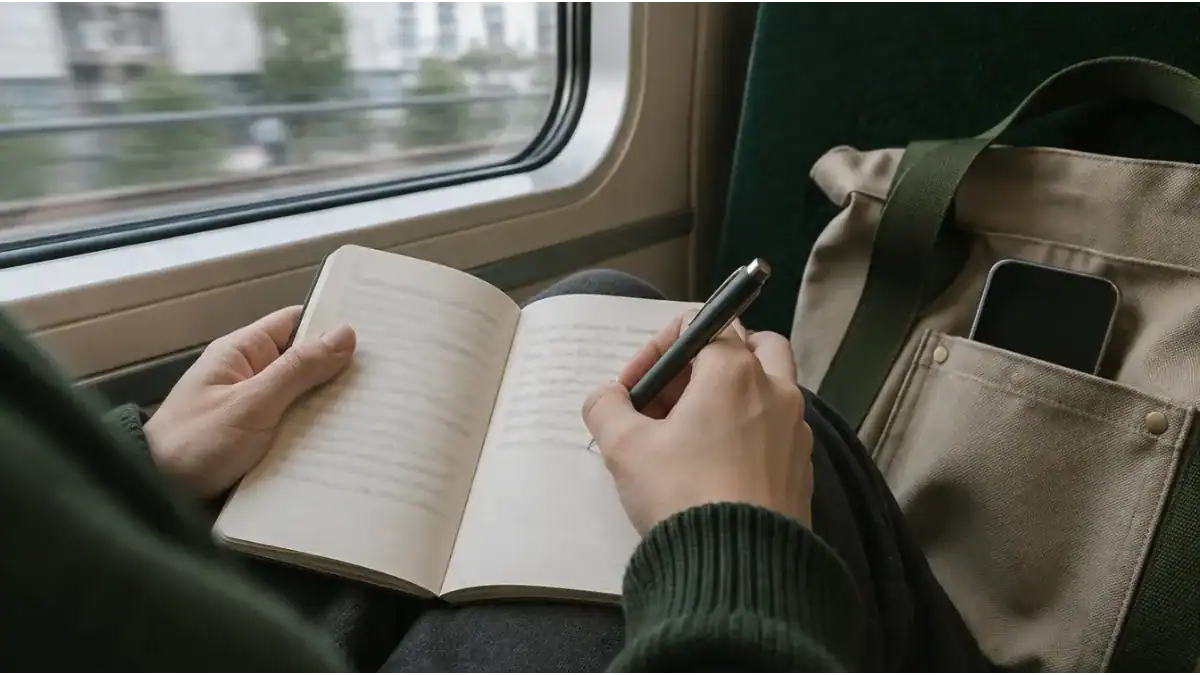
What to do instead of scrolling
The trick is to choose before boarding. An empty hand finds the phone. A hand that’s already holding a book mostly doesn’t. Nine things that fit inside a train or bus ride:
The phone-free commute
Nine things that fit inside a train ride
None of these need signal, which matters underground. Most don’t need power either, which solves a second problem: a phone that isn’t streaming video for forty minutes each way gets home with a lot more battery.
The tools are cheap. A slim paperback. A pocket notebook, like the Field Notes three-pack, and a pen that works. A book of small puzzles, such as The New York Times Mini Crosswords, which are short enough to finish between stops. If screens are how you read, a basic Kindle works too. It holds books and nothing else.
Driving? Then the phone-free commute is already the rule, at least on paper. The same idea applies at red lights and in the parking lot before you walk in.
Make the phone boring before you leave
Willpower is a bad plan at 7:40 in the morning. By then we’ve already used our best thinking getting out of the house. A few small setups do the job instead:
- Bag, not pocket. A zipped compartment turns a reflex into an errand. Most of the time we won’t bother.
- Load up at home. Download the album, the episode or the book on wifi, press play, then put the phone away.
- Let calls through, silence the rest. A Do Not Disturb schedule that matches your commute keeps you reachable in a real emergency and deaf to everything else.
- Pick a checkpoint. One planned look, at the transfer or when the train comes above ground. It’s easier to hold off when you know when the next look is.
Then start small. One direction. The ride home is usually easier, since work has stopped asking for things by then. Give it two weeks before judging it. In that mobile internet study, people reported feeling a little better day by day, not all at once.
Some rides you’ll cave by the second stop. Fine. Put it back in the bag and take the next stop.
None of this is dramatic. The phone goes in the bag and a book comes out. A few weeks in, there’s a ride home where we look up at our stop and realize we watched the whole trip. It’s a small thing. It’s also most of an hour a day.
Carry smarter. Commute better.
Common questions about a phone-free commute
What can I do instead of scrolling on my commute?
Look out the window, read a paper book, write a few lines in a notebook, listen to one album or podcast with the phone put away, plan the evening, do a paper puzzle, talk to someone, or do nothing for one stop. The ones that work best need no signal and are chosen before boarding.
How do I stop doomscrolling on the train?
Make the phone harder to reach and the alternative easier. Put the phone in a zipped bag compartment instead of a pocket, download audio at home and press play before boarding, silence everything except calls, and have a book or notebook already in hand. Start with one direction of the commute.
Is it bad to use my phone during my commute?
Not in itself. A phone is useful for tickets, maps and messages. The cost comes when scrolling takes the whole ride, because the commute is one of the few unclaimed gaps in the day for the mind to switch between work and home.
Does cutting phone time actually improve mood and focus?
In a 2025 randomized trial in PNAS Nexus, 467 people blocked mobile internet on their phones for two weeks. Screen time fell from 314 to 161 minutes a day, and well-being, mental health and sustained attention improved. A commute-only break has not been tested, so the size of the benefit at that scale is unknown.
What should I carry for a phone-free commute?
A slim paperback or e-reader, a pocket notebook and pen, and a paper puzzle book cover most rides. Wired or wireless headphones with audio downloaded in advance let the phone stay in the bag.
How long does it take to get used to not scrolling?
The first few minutes of each ride are the uncomfortable part, and boredom is normal. In the two-week mobile internet study, participants reported feeling progressively better day by day. Two weeks of one direction is a fair trial.
Life on the go should be easier.
One overlooked commute problem each week, and the simplest fix.
Keep reading
Mind & Commute
Your Commute Is Free Therapy
The ride home is the only roleless time in the day. How to use it.
Mind & Commute
Why Your Commute Feels Longer Than It Is
Time perception, clock-watching, and what makes a ride feel shorter.
City Commute
The Noise You’ve Stopped Hearing
Why the background roar of a commute still drains us.
Mind & Commute
We’ve Used Our Best Thinking Before We Leave
Why mornings run on defaults, and how to set better ones.